CVF-1500-3P Vacuum Cooler for Fruits and Vegetables — 3 Pallets, 1500kg per Batch, 30–50 min to 1–10°C
The CVF-1500-3P vacuum cooler handles 1500kg per batch on 3 pallets, cooling produce from 25–30°C to 1–10°C in 30–50 minutes.
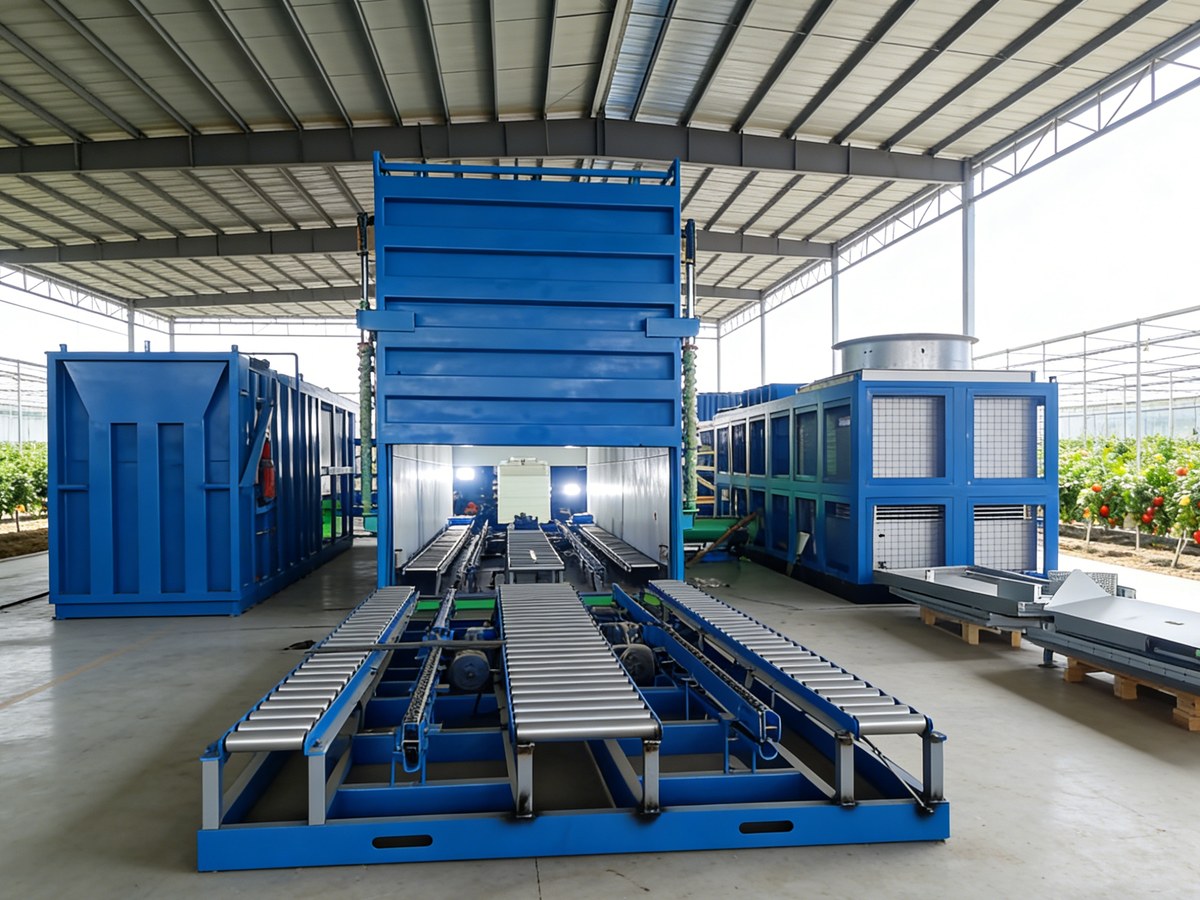
CVF-1500-3P is a 3-pallet vegetable vacuum pre-cooler: 1500kg per batch, ambient produce enters the chamber at 25~30°C and drops to 1~10°C in 30~50 minutes, chamber volume 11.24m³, ultimate vacuum ≤600Pa. This single model covers one day’s outbound volume of a small to medium-sized origin purchasing station.
Where it is used
| Scenario | Typical users | Load per batch |
|---|---|---|
| Leafy vegetables (lettuce, spinach, choy sum, Chinese kale, A-choy) | Planting bases, origin purchasing stations, cooperatives | 1500kg |
| Edible fungi (shiitake, king oyster mushroom, enoki) | Mushroom farms, post-harvest handling centers | 1500kg |
| Cut flowers (rose, lily, lisianthus) | Flower bases, flower exporters | 1500kg |
| Berries (strawberry, blueberry, cherry) | Fruit packing houses, cooperatives | 1500kg |
Three standard pallets are pushed into the chamber and loaded in one forklift pass; vacuum can be pulled as soon as loading is done, with no waiting for a full chamber.
Tightly structured leafy vegetables are not suitable for vacuum pre-cooling — baby cabbage, cabbage, napa cabbage and similar items have few internal voids and surface moisture that evaporates with difficulty, so they cannot be cooled through. Cold room pre-cooling or forced-air pre-cooling is recommended for such materials. Defining the product category clearly before selection is more useful than adjusting parameters afterwards.
How cooling works
Water boils at 100°C under normal pressure; when the chamber pressure is pulled below 600Pa, the boiling point of water drops to close to 0°C. Moisture on the surface of the produce evaporates at this pressure, and each 1kg of water evaporated carries away about 2500kJ of heat. The heat comes from inside the produce, so the whole batch cools simultaneously — it is not a case of the outside cooling first while the core stays hot.
| Step | Component | Function |
|---|---|---|
| ① Loading | Manual sliding door | Three pallets pushed into the chamber, door sealed |
| ② Vacuum pumping | Rotary vane vacuum pump 7.5kW | Pulls the chamber from normal pressure to ≤600Pa |
| ③ Evaporative cooling | Vacuum chamber (11.24m³) | Surface moisture boils and evaporates, carrying away sensible heat from the produce |
| ④ Water capture | Water catcher (evaporating temperature -5°C) | Condenses water vapor into water, reducing the vacuum pump load and preventing emulsification |
| ⑤ Heat rejection | Refrigeration system 64kW | Cooling capacity acts on the water catcher; heat is discharged outside the chamber by the condenser |
| ⑥ Stop | LS PLC + temperature sensing | Automatically ends when the set temperature is reached, then backfills pressure and opens the door |
Vacuum pumping and refrigeration are two systems working at the same time, not just hard pumping by the pump alone. If the water catcher does not condense water, all the water vapor enters the pump, the pump oil emulsifies quickly and pumping speed drops — this is the reason many sites run “slower and slower”. Chamber sealing is equally critical: if the door gasket is not compressed firmly, valve seals are not tight, or there are weld leaks, the vacuum level will not come up and the cycle time will be extended.
Technical parameters
Quick specifications
| Parameter | Value |
|---|---|
| Model | CVF-1500-3P |
| Number of pallets | 3 pallets |
| Load per batch | 1500 kg |
| Cycle time | 30~50 min |
| Inlet temperature | Ambient produce 25~30°C |
| Outlet temperature | 1~10°C (adjustable by product) |
| Chamber volume | 11.24 m³ |
| Ultimate vacuum | ≤600 Pa |
Full parameters (air-cooled standard configuration)
| Parameter | Value | Note |
|---|---|---|
| Chamber internal dimensions | L3650×W1400×H2200 mm | 3 standard pallets |
| Overall dimensions | L5380×W2262×H2576 mm | Subject to final layout |
| Cooling capacity | 64 kW | Evaporating temperature -5°C / condensing temperature 40°C |
| Total operating power | 31.5 kW | Full load |
| Compressor | Copeland ZR125KC-TFD-522 15HP ×2 | Scroll, dual compressors in parallel |
| Vacuum pump | 7.5 kW | Dalutong / Zhongde rotary vane pump |
| Condenser | Air-cooled fin type 3 kW | Rongyi |
| Power supply | 380V/50Hz/3P | Three-phase five-wire |
| Maximum operating current | 110.2 A | Including startup peak |
| Refrigerant | R22 | R404A available for export |
| Chamber material | Q235 carbon steel, painted | Inner and outer walls can be cleaned with a high-pressure water gun |
| Control | LS PLC + Weinview touch screen | Multi-language interface including Chinese/English/Spanish |
| Pneumatic components | AirTAC | — |
| Temperature sensing | PT100 Class A | Probe type, measures product core temperature |
Condensing method (difference between model suffixes A/W/E)
| Suffix | Condensing method | Applicable conditions |
|---|---|---|
| A | Air-cooled fin condenser | Does not depend on a cooling tower, ready to use once powered; choose it when the site needs to be relocated or there is no cooling water circulation |
| W | Water-cooled shell-and-tube + cooling tower | For origin stations with high ambient temperatures in summer and continuous multi-shift operation, condensing temperature is more stable |
| E | Evaporative condenser | Uses less water than water cooling, stable operation in hot and dry regions |
The parameters on this page are listed for the air-cooled configuration (CVF-1500A-3P); the water-cooled model is CVF-1500W-3P, and the evaporative-cooled version is calculated per project. Which one to choose depends on local ambient temperature, water source conditions and whether the unit is frequently relocated; confirm at the time of order.
Main configuration list
| System | Configuration | Origin |
|---|---|---|
| Refrigeration compressor | Copeland ZR125KC 15HP ×2 | USA |
| Vacuum pump | Dalutong / Zhongde 7.5kW rotary vane pump | Dongguan |
| Condenser | Rongyi air-cooled fin type | Zhejiang |
| Water capture system | Yuanxian self-made evaporator, evaporating temperature -5°C | Dongguan |
| Vacuum chamber | Q235 carbon steel, painted, manual sliding door | Guangdong |
| Control system | LS PLC + Weinview touch screen | Korea / Taiwan |
| Pneumatic system | AirTAC | Taiwan |
| Temperature sensing | PT100 Class A + LS module | Korea |
| Refrigerant and piping | R22, Danfoss valves | — |
Dual compressors in parallel is the actual practice on this model: if one fails, the other can maintain 50~60% capacity at reduced load; the two start in sequence for less impact on the power grid, and running only one under light load saves power. The manual sliding door is standard — simple structure, few failure points.
Why choose it
Loading capacity matches the origin pace 3 standard pallets at 1500kg is the common volume for two to three outbound rounds a day at an origin purchasing station. The chamber is 11.24m³, so pallets go in without crowding and airflow can pass around them.
Cooling relies on evaporation, not air Vacuum pre-cooling cools the whole batch simultaneously; there is no “cold outside, hot core” as in a cold room. A cold room takes more than ten hours to bring 1500kg of leafy vegetables down to 5°C; this model discharges in 30~50 minutes.
Controllable weight loss The weight loss rate of vacuum pre-cooling is 1~2%, clearly lower than the 3~5% of open-air cooling. For leafy vegetables and fungi settled by weight, this difference is direct money.
Parts are easy to find on the market Copeland scroll compressors, Dalutong rotary vane pumps, Danfoss valves and the LS control system are all regular parts with wide service network coverage in China, so repairs do not wait for imported parts.
More capacity options can be compared in the vegetable vacuum cooler series. If you are not sure whether 1 pallet, 3 pallets or 4 pallets is suitable, you can first estimate with the selection assistant based on daily outbound volume and product category.
FAQ
Is 1500kg net vegetable weight or gross weight?
It is calculated as the net weight of material loaded into the chamber; 1500kg is the standard load. Actual loading varies with product category and stacking method: leafy vegetables in baskets stacked loosely may reach about 1400kg; fungi in regular turnover boxes can reach the nominal load. Confirm the loading basis with the order.
The cycle time is 30~50 minutes — where does the difference come from?
The difference comes from product variety, initial temperature, loading density and how fast the vacuum level is reached. Leafy vegetables have plenty of surface moisture and high respiration heat, so the time is on the longer side; edible fungi are on the shorter side. Vegetables harvested on rainy days carry surface water, and the initial dewatering stage takes up part of the time.
Is a cooling tower required?
The air-cooled configuration (A) does not require a cooling tower and can be used once powered; it suits sites that are frequently relocated or have no circulating water conditions. The water-cooled configuration (W) requires a cooling tower and water pump, and gives more stable condensing temperature during high summer temperatures and continuous multi-shift operation.
How much electricity does one cycle consume?
Total operating power is 31.5kW, but the compressor and vacuum pump are not at full load throughout. Estimated at a 40-minute cycle, power consumption per batch is around 15kWh, fluctuating in practice with initial temperature, load and ambient temperature. Size the wiring with margin for the maximum operating current of 110.2A; a main switch of 150A or above is recommended.
The chamber is carbon steel — will it rust?
The inner and outer walls of the chamber are Q235 carbon steel with anti-rust paint treatment. Each run puts the chamber under negative pressure and high humidity, so it relies on the integrity of the paint film and on backfilling pressure and draining after operation. Routine cleaning with a high-pressure water gun is fine, but paint film knocks must be touched up promptly; leaks directly affect the vacuum level.
To have the configuration checked against your product category, daily outbound volume and site conditions, contact us.
Related technical guides
Cooling Time Calculation Guide
How to estimate cooling time based on product type, quality, initial temperature and target temperature.
Vacuum Cooler Selection for 5 Climate Zones
Tropical, dry-hot, temperate, cold, high-altitude — condenser selection, compressor correction, voltage adaptation, and
Water Catcher Design and Efficiency in Vacuum Cooling Systems
Engineering analysis of the water catcher (condenser / cold trap) in vacuum cooling: sizing formulas, heat-load calculation
Interested in CVF-1500-3P Vacuum Cooler for Fruits and Vegetables — 3 Pallets, 1500kg per Batch, 30–50 min to 1–10°C?
Contact us for a quote or technical consultation.
Send Inquiry →