When asked "how much can this machine process in a day," if you simply divide the hours in a day by the cooling time, the result is often far higher than reality. The reason is simple: the equipment is actually refrigerating for only 60–70% of each batch cycle; the rest is spent on repressurization, door opening, loading/unloading, and cleaning.
Let's state the conclusion first: Daily throughput = effective working time ÷ batch cycle × load per batch × utilization rate. The cycle must include loading, unloading, and cleaning; effective working time is taken as 16–20 hours, and utilization rate as 0.8–0.9. Below, these numbers are broken down one by one.
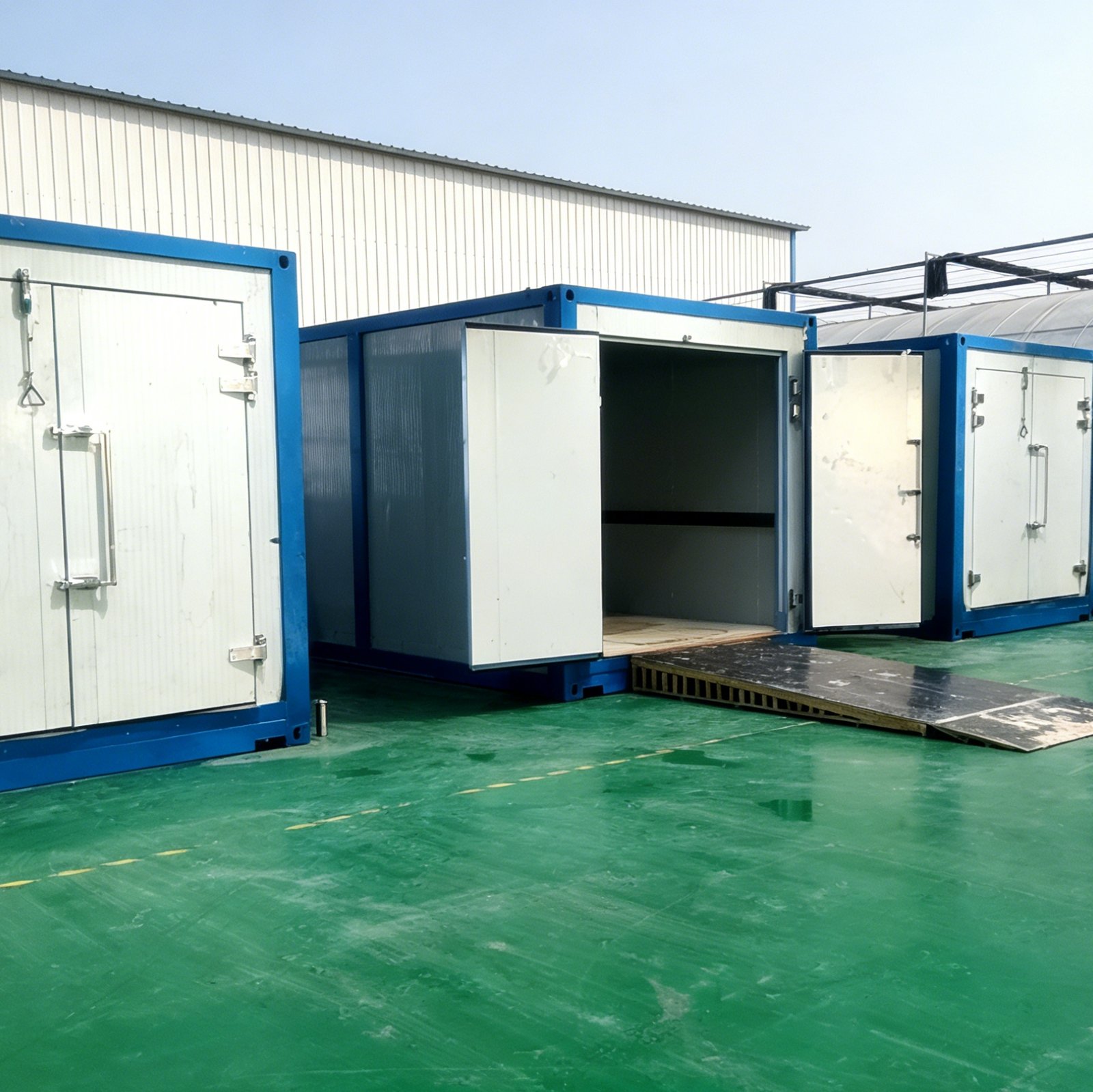 Vacuum precoolers installed side by side on site; the door of the middle unit is open, pallet decking is visible inside the chamber, and goods enter and exit through the doorway along the ramp.
1. The batch cycle consists of four time segments
Cooling time is only one segment. In actual operations at field edges or buying stations, a batch goes through four segments from entry to exit:
| Stage | Typical duration | Notes |
|---|---|---|
| Rough pumping + cooling | 20–35 min | Fruits and vegetables drop from ambient 25–30°C to 0–5°C; varies with variety, packaging, and loading density |
| Repressurization and door opening | 2–5 min | Vacuum must be broken to atmospheric pressure before the door can open; time differs slightly by door type |
| Pallet in/out, door closing and sealing | 5–15 min | Forklift entry/exit per pallet is about 1–3 min; the larger the chamber and the more pallets, the longer this segment |
| Cleaning, inspection, waiting for goods | Allocated per shift | End-of-shift chamber cleaning, door gasket checks, waiting for the next truckload |
Small chambers (2–4 pallets) typically have a batch cycle of 40–50 minutes, medium (6–8 pallets) 50–60 minutes, and large (10+ pallets) 60–70 minutes. These are empirical values summarized from on-site operation records; actual values are affected by site width, number of forklifts, and continuity of supply, and can vary by ±20%.
2. How to calculate daily throughput
Based on 16 hours of effective operation and a utilization rate of 0.85 (two-shift operation is common in harvest season, after deducting shift handover and waiting time):
| Model (capacity class) | Load per batch | Typical cooling time | Batch cycle | Theoretical batches per day | Daily throughput (×0.85) |
|---|---|---|---|---|---|
| CVF-1000 | 1000 kg | 25 min | 45 min | 21 batches | approx. 18 t |
| CVF-2000 | 2000 kg | 30 min | 50 min | 19 batches | approx. 32 t |
| CVF-4000 | 4000 kg | 35 min | 60 min | 16 batches | approx. 54 t |
| CVF-6000 | 6000 kg | 40 min | 70 min | 13 batches | approx. 66 t |
The daily throughput figures in the table are upper-bound estimates, not guaranteed values. In peak harvest season, if supply is intermittent, batches are underloaded, or goods must be sorted by variety inside the chamber, actual output will be lower than the table figures.
The same calculation method also applies to food vacuum rapid coolers, with the difference being the inlet temperature: hot food enters at 80–90°C, the cooling segment is longer, and the batch cycle is generally 10–20 minutes longer than for precoolers, with correspondingly fewer batches per day.
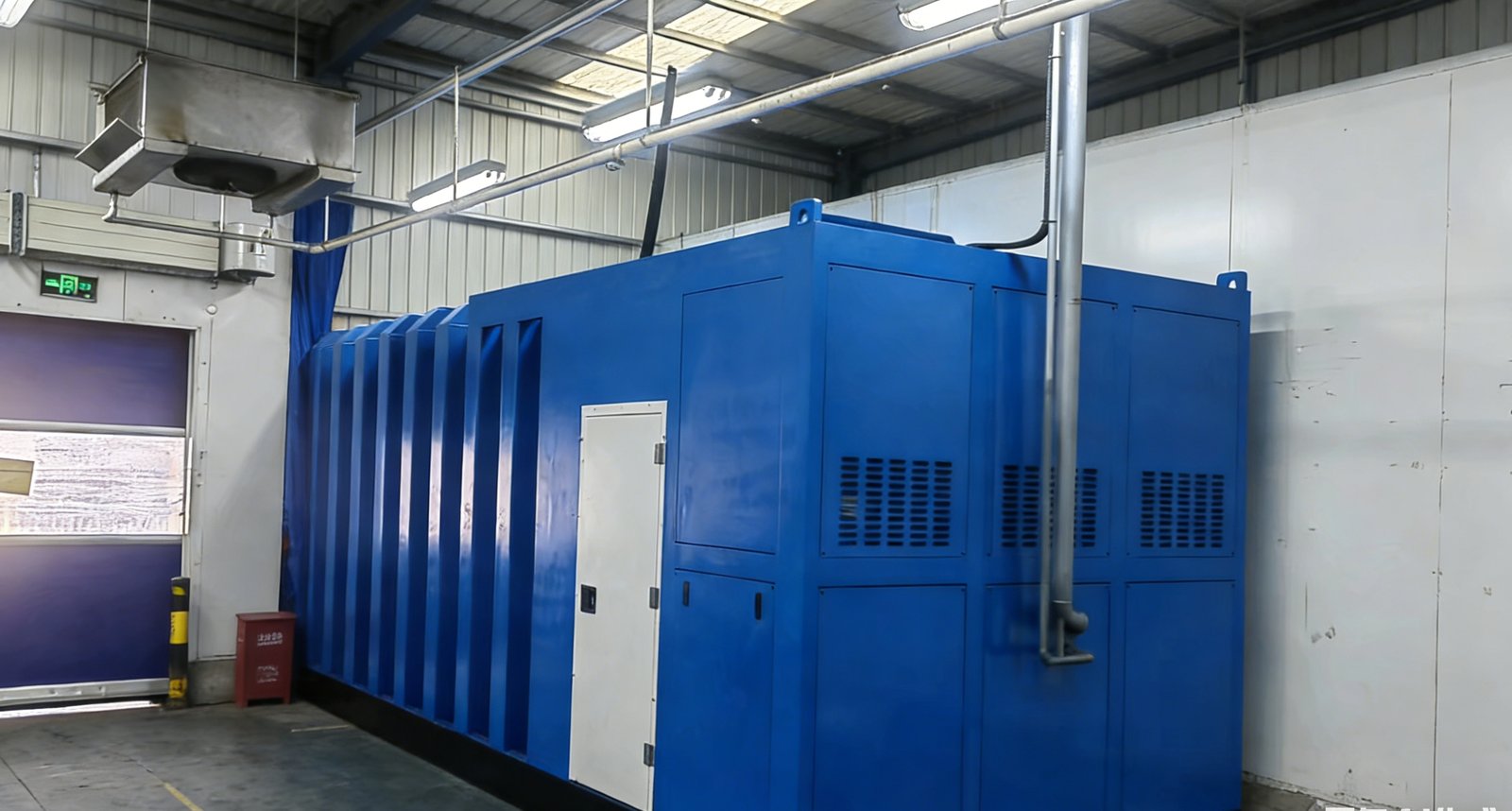 Large vacuum precooler chamber inside a workshop, with a heat-dissipation duct structure at the rear and lifting rings on top. Equipment dimensions determine how many pallets fit per batch and also determine changeover time.
3. Three common calculation errors
First, using cooling time as the cycle. If cooling takes 30 minutes and you calculate 30 minutes per batch, 16 hours a day gives 32 batches—this result ignores repressurization, door opening, and changeover. At a 50-minute cycle, the same time yields only 19 batches; the 40% difference is the gap between paper capacity and actual capacity.
Second, calculating on a 24-hour basis. Equipment does not run continuously. Harvesting has peaks and troughs, the machine may be shut down at night, and cleaning and maintenance take time. Figures calculated on a 24-hour basis are usually only 1.5 times those calculated on a 16-hour basis, and are difficult to achieve on site.
Third, choosing an oversized chamber but underloading it. A larger chamber lengthens the batch cycle (both changeover and rough pumping take longer); if each batch is only half loaded, you are processing less weight with a longer cycle, and daily throughput actually drops. Whether chamber size matches throughput can be judged by loading density; the common range for fruit and vegetable precooling is 125–150 kg/m³, roughly 4–7 in L/kg. For the specific method, see Loading Density and Chamber Sizing.
4. Reverse calculation: sizing for a given daily throughput
Suppose a producing-area buying station needs to process 30 tonnes of leafy greens per day, with the harvest peak concentrated from 10 a.m. to 8 p.m., and effective operation taken as 16 hours:
- At a 50-minute cycle and 2 tonnes per batch, 19 theoretical batches per day = 38 tonnes; multiplied by 0.85, about 32 tonnes, which just covers the 30-tonne requirement;
- If a peak day requires 40 tonnes, 24 batches are needed at the same cycle; 16 hours is not enough, so either extend to 20 hours (23 batches) or increase the load per batch;
- The way to increase load per batch is to use a larger chamber, but this also lengthens the cycle; the two must be calculated together, not by looking at chamber size alone.
Another solution is two medium chambers: operating alternately, one cooling while the other is being unloaded and reloaded, the idle gaps in each unit's cycle are filled by the other, giving daily output close to 1.8 times that of a single unit, and retaining half the capacity in the event of a breakdown. The cost is increased footprint and number of installed units.
Which path to choose depends on three site conditions: whether supply is continuous, whether the site can accommodate two units, and how high the harvest-season peak is. For how to estimate cooling time itself, refer to the method based on specific heat and temperature difference in the Cooling Time Calculation Guide.
5. Four numbers to clarify before quoting
- Average daily volume and peak volume: The average determines the chamber capacity class; the peak determines whether two units or extended hours are needed.
- Inlet temperature and target temperature: Whether produce enters at ambient temperature or has already been hydrocooled; whether the target is 0–5°C or 2–8°C.
- Packaging and stacking method: Crates, bags, or bulk, which directly affect loading density and internal airflow channels.
- Shift pattern and cleaning schedule: How many shifts per day, whether the chamber is cleaned each shift, and whether there is a night shift—these determine whether effective working time is taken as 16 or 20 hours.
Only when these four numbers are reported accurately does the daily throughput estimate have meaning. For the equipment's own capabilities, see the capacity classes and chamber dimensions of Fruit and Vegetable Vacuum Precoolers; for food lines, see Food Vacuum Rapid Coolers.
If you have a set of daily throughput and site conditions on hand, send us these four numbers and we will calculate the equipment capacity class and number of units for you based on the actual cycle.