Interested in a Similar Solution?
Tell us about your product and capacity — we will prepare a tailored proposal for your application.
Ask About This Solution →Cherries start counting time from the moment they are picked. The flesh is soft, the stems are thin, and the skin is delicate. Left at ambient temperature for a few hours, the stems brown first, then the fruit surface wrinkles, and after that comes softening and weeping. For any origin that has export or long-distance shipping orders, field heat must be removed on the day of harvest — lose a step, and the goods drop a grade.
This 5-ton cherry precooling solution is built around that rhythm: 5000 kg per batch, one box in and one box out, with a water spray system, bringing fruit down to 0–10°C in 30–45 minutes. Power is 480V/60Hz/3P, an export project configuration.
Project background: 5 tons per batch, several cycles a day
The cherry season is short, and the harvest peak often lasts only two to three weeks. Morning deliveries arrive truck after truck while the cold store waits to load containers. If a precooler handles only one or two tons per box, workers have to open and close the door repeatedly and reload pallets repeatedly — loading and unloading alone eats up most of the time.
So this project sets batch capacity directly at 5000 kg, with internal chamber dimensions of L4500×W2500×H2700mm and a volume of 30.3m³. Goods go in by forklift as a full pallet and come out the same way. At 5 tons per box, scheduled by shift with allowances for loading, unloading and cleaning, throughput can keep up with the harvest rhythm. For how different capacity tiers map to site space and shifts, see the model comparison on the fruit and vegetable vacuum precooler product page.
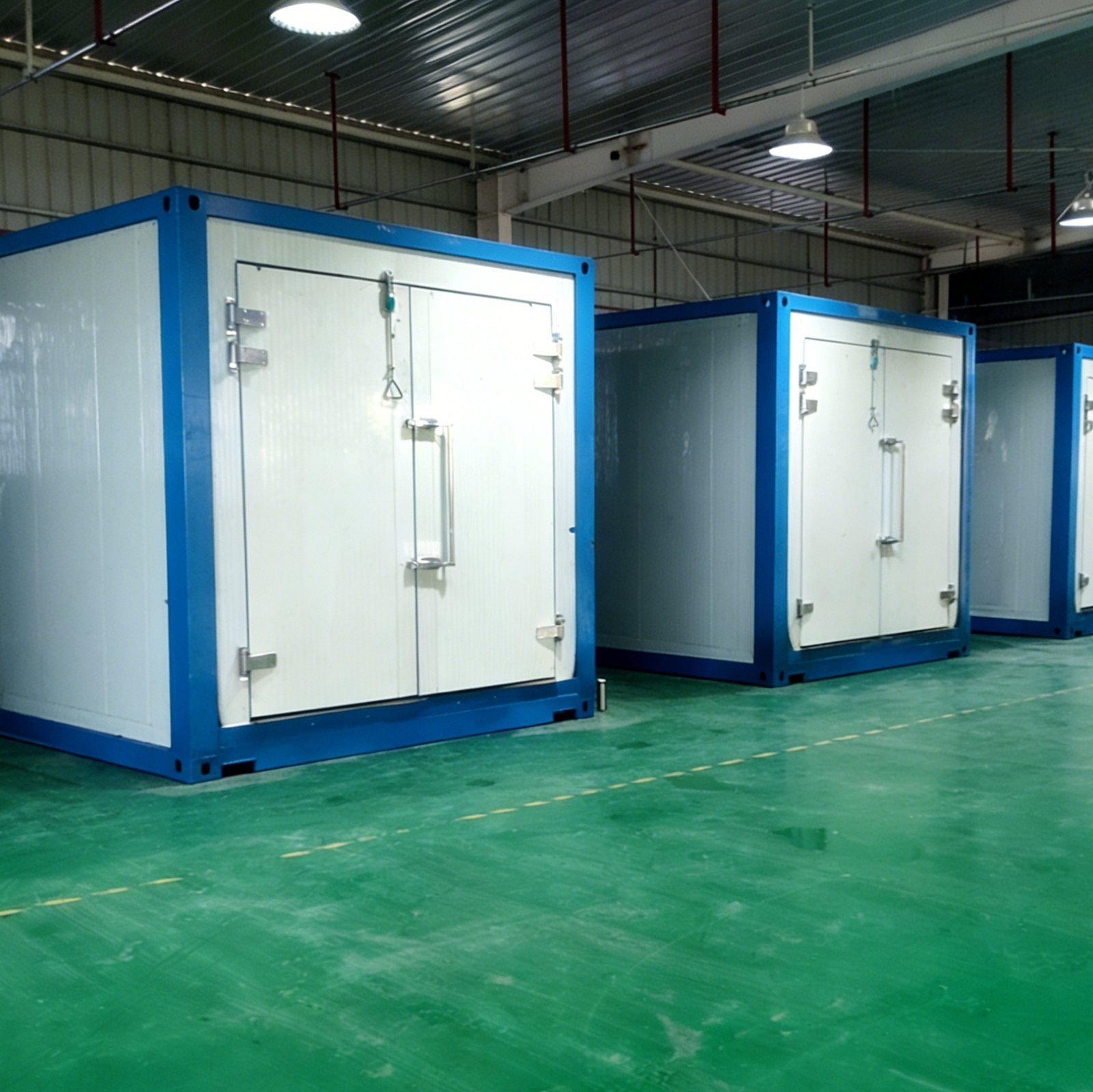
Insulated chamber and heavy-duty sealed door of the box-type vacuum precooler; origin-site models are typically loaded and unloaded by forklift as full pallets
Site challenges: fast cooling without drying the fruit out
Vacuum precooling works by water boiling at low temperature under low pressure and carrying away latent heat. Moisture on the fruit surface evaporates and the temperature drops, but water is lost at the same time. Leafy vegetables can lose a little water without it showing; cherries are different — once the skin loses water and wrinkles, marketability drops a grade immediately, and stem browning comes sooner as well.
This is the unavoidable trade-off in cherry precooling: to go fast, you have to pull harder, and pulling harder means more water loss. Extending pump-down time to lower the water loss rate means giving up the pace of the season, and receiving stations cannot afford to wait.
The second issue is temperature uniformity. Once crated, cherries stack on pallets, and the vapor diffusion path around fruit at the core of the box differs from that at the outer layer. With vacuum alone, the outer layer cools fast and the core lags; measured after the box comes out, the temperature spread holds the batch back.
Solution and configuration: vacuum handles cooling, water spray handles moisture retention
To address these two points, this CVF-5000 capacity tier machine (5 tons/batch) adds a complete water spray circulation system on top of the standard refrigeration and vacuum systems: a 4kW spray circulation pump and a 4kW agitator, with two Yuanli circulation pumps. During operation, the chamber forms a dual cooling environment of water bath plus vacuum — the water film covers the fruit surface and reduces evaporative water loss under vacuum, while agitation brings water temperature and fruit temperature closer together, flattening the gap between core and outer layer.
The cost should also be stated clearly: this auxiliary system adds 8kW of power and internal water lines and agitation structures inside the chamber, and cycle time is slightly longer than a pure vacuum solution. For high-value berries such as cherries and blueberries, trading a little time and electricity for appearance pays off; for leafy vegetables and root crops, this system is usually unnecessary.
Main configuration as follows (all taken from the project proposal documents):
| Item | Parameter |
|---|---|
| Equipment model | CVF-5000 capacity tier (5 tons/batch, with water spray function) |
| Batch capacity | 5000 kg, forklift full-pallet in and out |
| Cycle time | 30–45 minutes |
| End-point temperature | 0–10°C |
| Chamber volume / internal dimensions | 30.3m³ / L4500×W2500×H2700mm |
| Condenser (spiral evaporator) cooling capacity | 364kW (313,000 kcal/h) |
| Refrigeration compressor | Bitzer CSH9553-180Y, 124.4kW |
| Vacuum pumps | Leybold 5.5kW × 5 units |
| Condensing method | Evaporative condenser, 7kW |
| Ultimate vacuum | ≤600Pa |
| Water spray system | Spray circulation pump 4kW + agitator 4kW + Yuanli circulation pumps ×2 |
| Operating power / maximum current | 166.9kW / 350A (proposal recommends a 450A breaker) |
| Power supply | 480V/60Hz/3P |
| Equipment weight | 16500kg |
| Overall dimensions (excluding condenser) | L11.5×W3×H3.1m (source document notes actual confirmed dimensions prevail) |
The chamber door is hydraulic. Moving a 5-ton pallet of goods by hand is not realistic; hydraulic opening and closing is what keeps the sealing surface compressed consistently from batch to batch — once a vacuum chamber leaks, pump-down time stretches immediately and the end-point temperature can no longer be held.
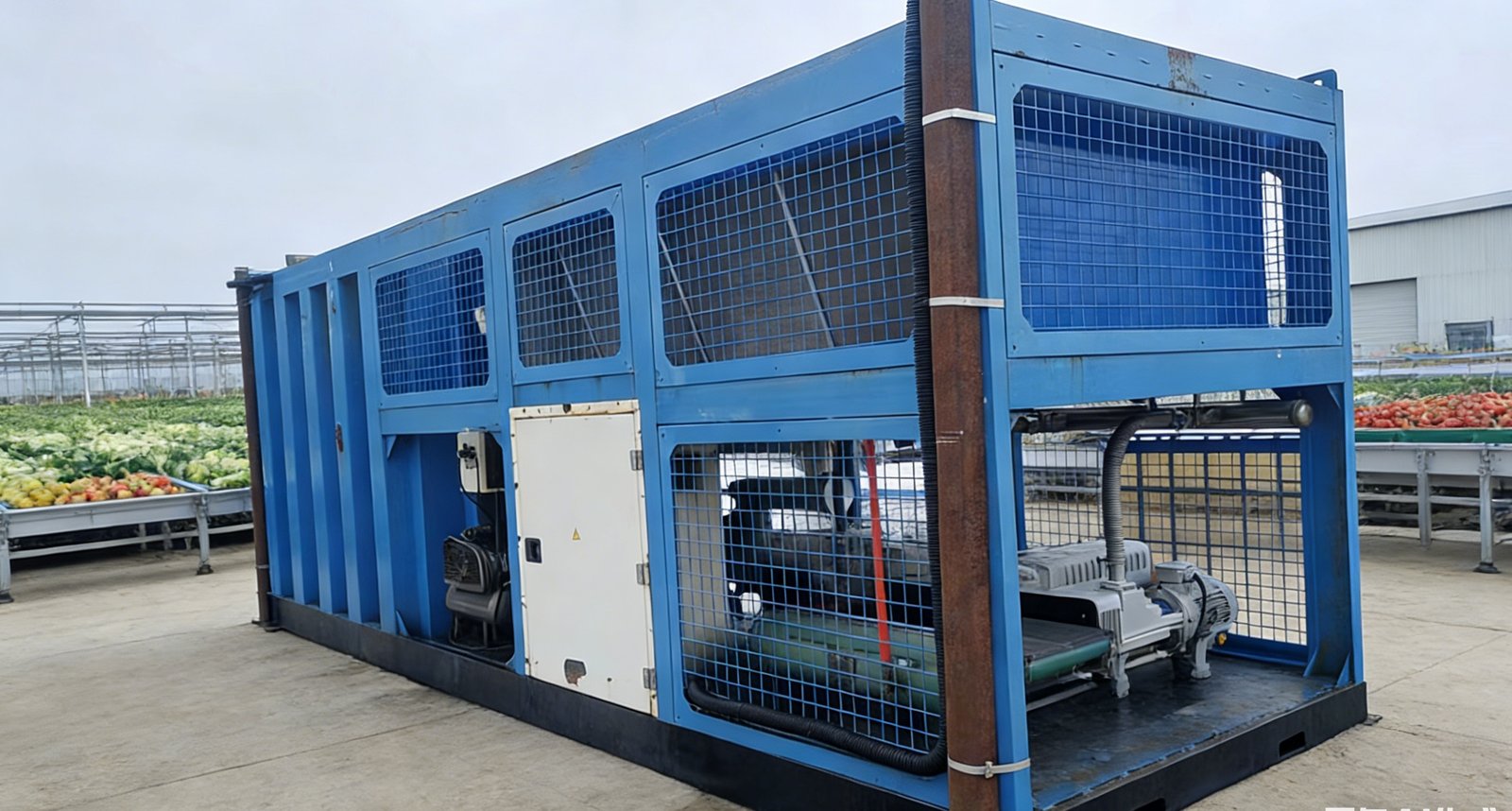
Complete unit installed at an origin site; pump sets and tanks are visible inside the steel frame
Operating data: 30–45 minutes per box, how the parameters check out
The proposal gives a cycle of 30–45 minutes per batch with an end point of 0–10°C. This range is not arbitrary; it corresponds to the matched result of 364kW of condenser cooling capacity, a single 124.4kW screw compressor and five vacuum pumps: the pump-down phase pulls chamber pressure to ≤600Pa, water boils at low temperature and carries away heat, and the condenser condenses the vapor to keep moisture out of the pumps and prevent emulsification.
Note that these proposal documents do not record the measured inlet temperature or measured water loss rate for the batch; this article only states the design parameters found in the documents. Actual water loss rate depends on variety, maturity and packing method, and the cooling curve normally has to be confirmed by an on-site trial; the order confirmation documents and on-site trial cooling records prevail.
The equipment itself weighs 16500 kg; with the evaporative condenser and foundation added, floor load capacity and lifting access must be checked against the foundation drawing before installation. Operating power is 166.9kW and maximum current 350A; electrical capacity and breaker sizing must be reserved to these figures, not guessed from nameplate power.
Who this configuration suits
- Origin receiving stations or processing plants for berries such as cherries and blueberries, at around 5 tons per batch with multiple cycles per day;
- Fruit that will spend a long time in sea freight or long-distance shipping, where appearance and stem condition directly affect grade;
- Export projects where the power supply is 480V/60Hz;
- Sites that can accommodate the full 11.5m long, 3m wide unit and provide forklift full-pallet access.
If the site is smaller and only 1–2 pallets of small batches are needed, the CVF series also offers 1000kg and 2000kg tiers. If you are a food factory processing cooked foods, that is a different product line using the food vacuum rapid cooler, with completely different operating conditions and configuration logic. To see actual configurations from other origin projects, browse the customer case library.
The real difficulty in cherry season is not bringing the temperature down; it is bringing it down consistently, batch after batch, without the fruit changing appearance, through those two peak harvest weeks. The solution, the configuration and the site conditions all have to line up for the cycle to hold. If you have specific throughput, fruit variety and site conditions, send us the parameters and we will calculate a configuration for your site: https://www.vacuum-fresh.com/contact/
Interested in a Similar Solution?
Tell us about your product and capacity — we will prepare a tailored proposal for your application.
Ask About This Solution →