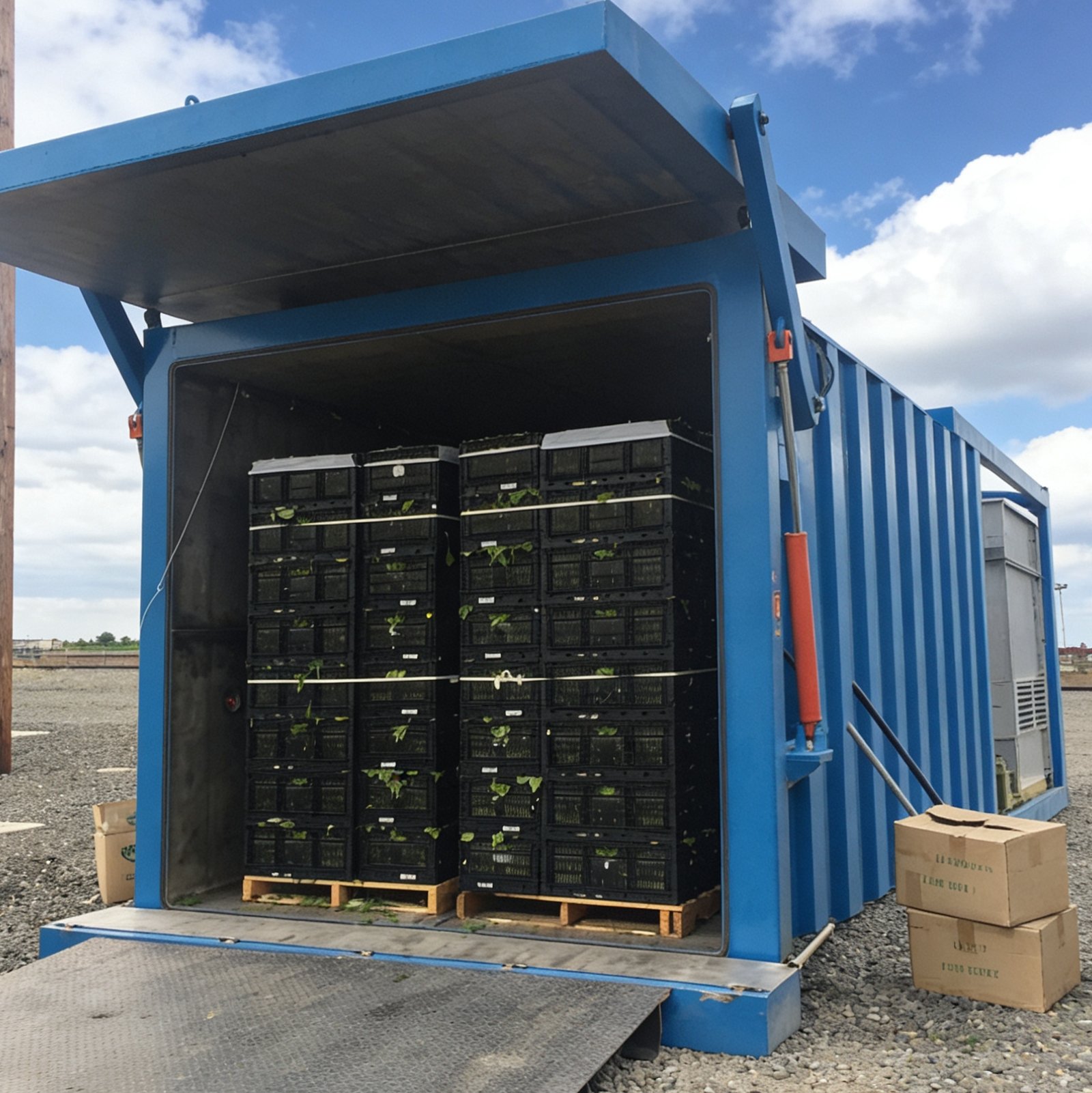
8000 kg Fruits and Vegetables Cooled from Ambient to 0~10°C in 20~30 Minutes: 16-Pallet Vacuum Precooling Configuration for Brazil
Brazil fruit and vegetable origin project uses CVF-8000-16P stainless steel vacuum precooler: 16 pallets, 8000 kg per batch, cooling postharvest produce from
Interested in a Similar Solution?
Tell us about your product and capacity — we will prepare a tailored proposal for your application.
Ask About This Solution →The moment fruits and vegetables are harvested, they are racing against time. The leaves are still respiring and still generating heat. If field heat is not removed from the crates, all the subsequent cold storage, container loading, and transport is just preserving a product that has already deteriorated. Whether the origin site can pull down a batch quickly and uniformly directly determines how far the goods can travel.
What this project does is make the “origin cooling” stage solid: a batch of 16 pallets, 8,000 kg of fruits and vegetables, cooled from post-harvest ambient temperature down to 010°C, with the entire batch completed in 2030 minutes.
Project Background
The project is located at a fruit and vegetable origin site in Brazil. The conditions at this end are fairly typical: a concentrated harvest season, large single-batch volumes, and fruits and vegetables stacked directly in the packing area with field heat still in them, waiting to be cooled. If left to natural dissipation and ordinary cold storage for slow temperature pull-down, leafy vegetables wilt and cut surfaces oxidize over time, and by the time they are loaded for cold storage or shipment, quality has already dropped a notch.
What the customer wanted was to turn cooling into a process that can be timed — pallets in and out as whole batches, ready to go once cooled, without workers having to turn or wait.
Site Challenges
The first is the large single-batch volume. It is set up for 16 pallets and 8,000 kg per batch, with dense stacking and limited gaps between pallets. Blowing cold air at it only cools the surface layer quickly; the core is still hot.
The second is that the cabinet must hold up. What the origin site needs is a cabinet that runs long-term, resists moisture, and is easy to clean, and since whole batches are pushed in and out on pallets, the door opening and closing and the load-bearing capacity must keep up with the pace.
The third is the hot and humid environment. The origin environment has high humidity. If the condensing end is configured conventionally, efficiency easily drops in summer, the pressure inside the cabinet cannot be maintained, and the cycle gets dragged out.
Solution and Configuration
The solution is one CVF-8000-16P fruit and vegetable vacuum precooler configured for 16 pallets and 8,000 kg per batch.
| Item | Configuration |
|---|---|
| Equipment model | CVF-8000-16P (16 pallets, stainless steel) |
| Batch capacity | 8000 kg |
| Cycle time | 20~30 minutes |
| Vacuum chamber internal volume | 52.3 m³ (internal L9500 × W2500 × H2200 mm) |
| Ultimate vacuum | ≤ 600 Pa |
| Cooling capacity | 677 kW (582100 kcal/h) |
| Refrigeration compressor | Bitzer CSH9573-240Y, 216 kW |
| Vacuum pump | Leybold SV0630B × 4, 74 kW |
| Evaporative condenser | 15.8 kW |
| Final product temperature | 0~10℃ |
| Power supply | 380V/60Hz/3P |
| Maximum operating current | 673 A (800 A breaker recommended) |
| Equipment weight | 32500 kg |
| Dimensions | L30000 × W6500 × H2700 mm |
| Chamber and conveying | 304 stainless steel vacuum chamber, stainless steel hydraulic door, stainless steel conveying system |
How this system works: whole pallets are pushed into the sealed vacuum chamber, the pressure inside is lowered below 600 Pa, the boiling point of water drops accordingly, and the moisture in the fruits and vegetables vaporizes at low temperature. The vaporization process continuously carries heat away. Cooling proceeds from inside the product outward, not by air convection, so even with densely stacked pallets and tightly packed leaves, the core temperature still reaches target.
A key link is where the water vapor goes. The water vapor vaporized inside the chamber is condensed into water by the cold trap, and the refrigeration system then carries the heat out of the equipment. The cold trap is a prerequisite for this process: only after it captures the water vapor can the vacuum pump keep maintaining the pressure, and only then will the chamber not lose pressure due to accumulated moisture. This is also why a vacuum precooler must be equipped with a complete refrigeration system and cannot rely on vacuum pumping alone.
For the condensing end, an evaporative condenser was selected for the hot and humid origin site, giving more stable resistance to ambient temperature than a conventional configuration. For complete product and configuration information on fruit and vegetable vacuum precoolers, see the fruit and vegetable vacuum precooler product page.
Measured Results
With the configured solution, the core data from this system running at the origin site is:
- Batch capacity: 16 pallets / 8000 kg;
- Cycle time: 20~30 minutes;
- Final product temperature: 0~10℃;
- Ultimate vacuum: ≤ 600 Pa.
The entire batch completes cooling inside the sealed vacuum chamber, isolated from outside air throughout. The output temperature is far more uniform than natural dissipation or slow cooling in cold storage, and the same batch is consistent from start to finish without manual turning. The chamber and conveying system are both stainless steel, the hydraulic door opens and closes, and pallets move in and out as whole batches, reducing manual handling at the origin site.
The complete unit weighs 32500 kg and measures 30 m × 6.5 m × 2.7 m, making it a large floor-standing system. Specifications like these require advance calculation for transport, lifting, and floor load-bearing, and site clearance and feed access should be confirmed together during the solution stage.
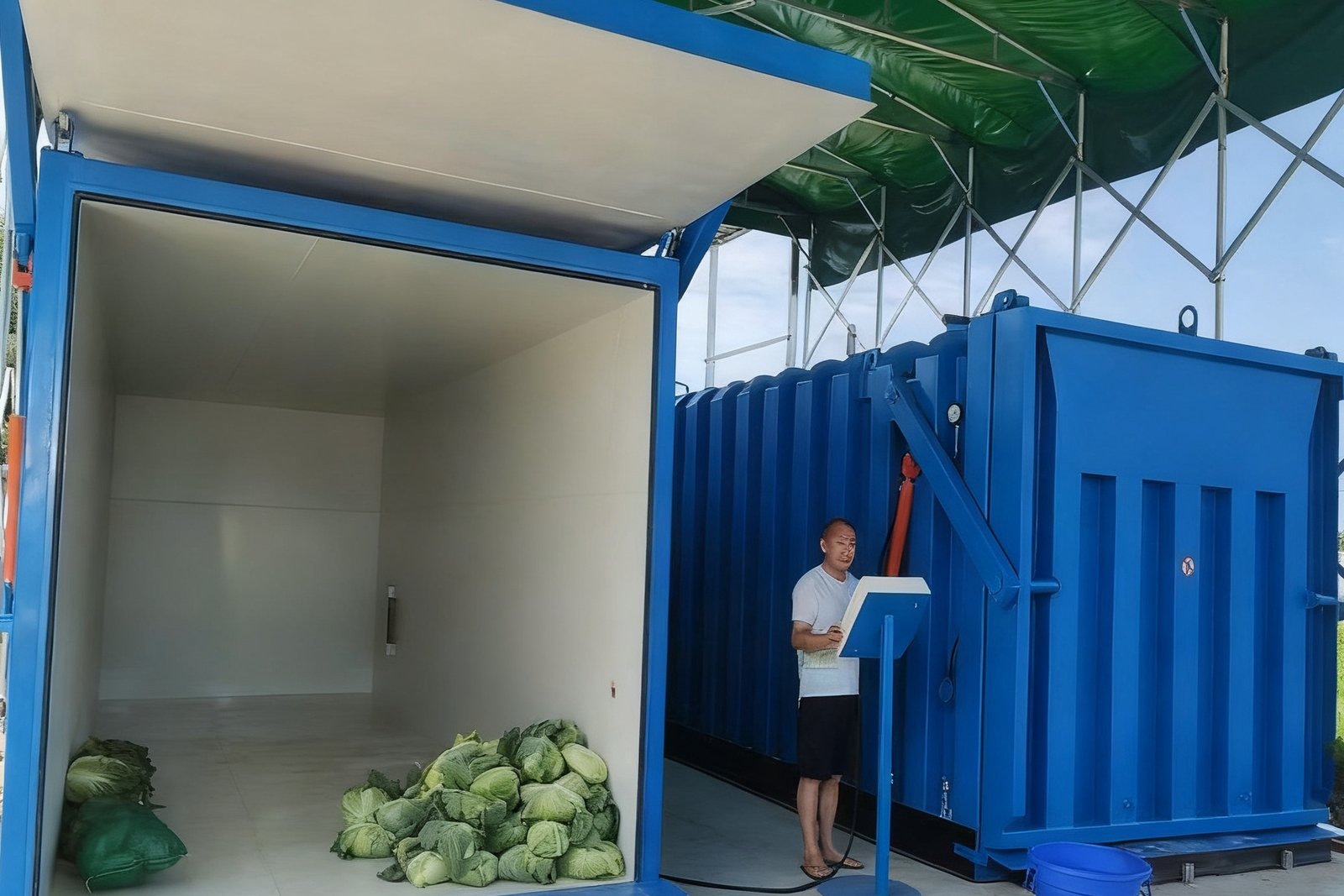
Note: This project case sheet does not record inlet temperature and moisture loss item by item. Inlet is based on post-harvest ambient-temperature fruits and vegetables (approximately 25~30℃). Items not listed above are subject to the order confirmation documents.
Summary
In origin precooling, what is truly difficult is not “cooling down” but “cooling a whole batch uniformly to target.” At a volume of 16 pallets and 8,000 kg per batch, it is difficult to complete within 20~30 minutes by natural dissipation and ordinary cold storage, whereas vacuum precooling compresses this stage into a controllable process: whole batches in, whole batches out, ready to go once cooled.
If your origin site also handles whole pallets per batch, you can send us the number of pallets per batch, weight per batch, post-harvest temperature, and required end temperature, and we will calculate the configuration based on actual working conditions. For similar origin and export precooling cases, see our customer case collection; to discuss a specific configuration, contact us.
Interested in a Similar Solution?
Tell us about your product and capacity — we will prepare a tailored proposal for your application.
Ask About This Solution →