When selecting vacuum cooling equipment, the first question asked is "how many kilograms per batch," but what really determines whether the unit works well is how much space that batch occupies inside the chamber. 4,000 kg of leafy greens and 4,000 kg of packaged cherries require very different chamber volumes. The conclusion first: loading density is a number that must be calculated before selection; an oversized chamber is more common than an undersized one, and the cost is longer pre-pumping time, relatively insufficient pump power, and wasted equipment cost.
1. How to calculate loading density
Two numbers are enough: batch capacity (kg) ÷ effective chamber volume (m³) = loading density (kg/m³). Looked at the other way it is more intuitive: chamber volume (L) ÷ batch capacity (kg) = space occupied per kilogram of product (L/kg).
We use both numbers in project reviews. kg/m³ is used to compare against industry ranges, and L/kg is used to quickly judge whether the chamber and batch capacity match. The reason is that L/kg puts "chamber" and "batch capacity" directly side by side, with no further conversion needed.
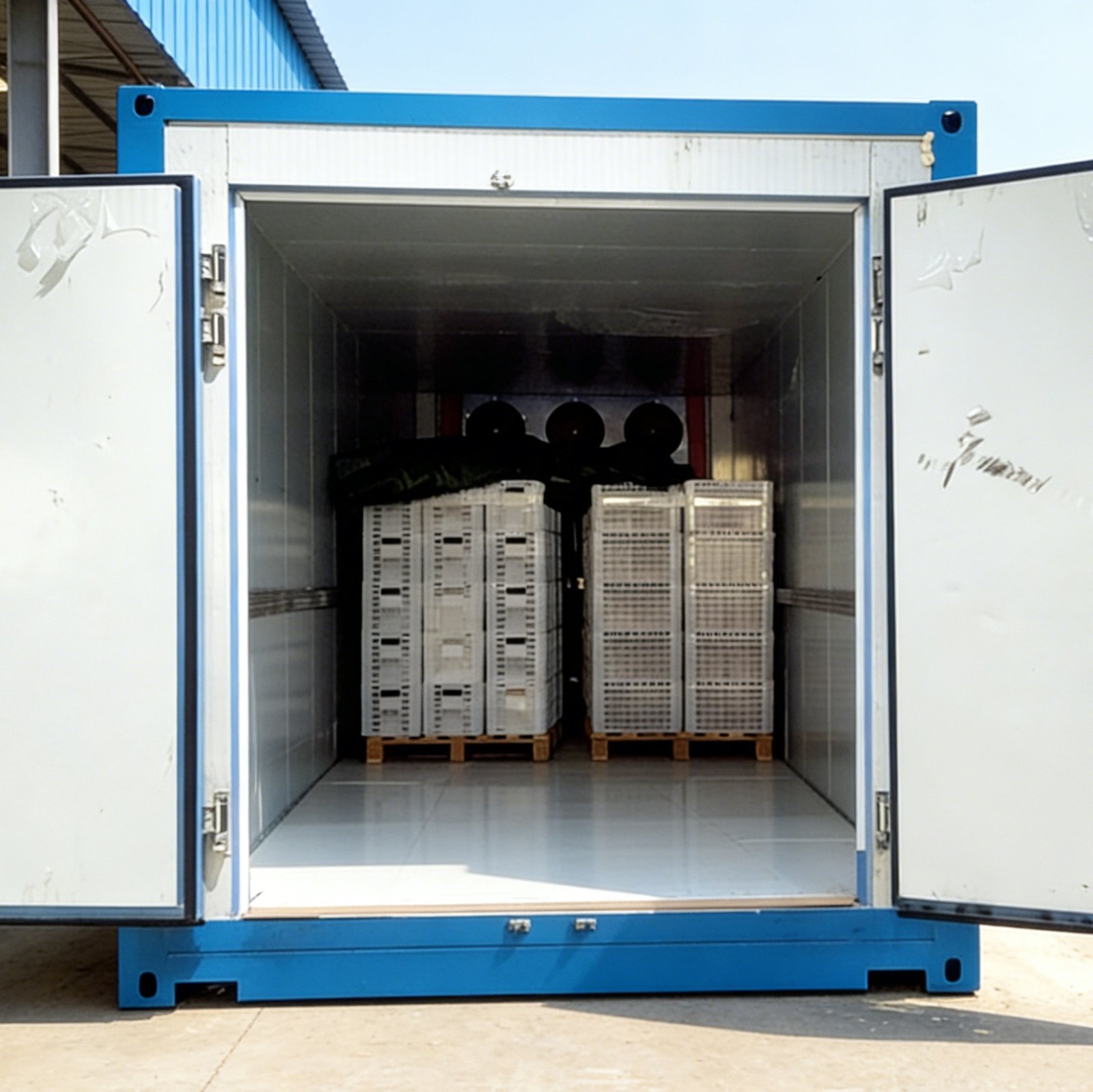 Interior of a vacuum precooler with double doors open: crates on two rows of pallets are arranged along the length of the chamber, and air flow channels must be left at the side and top evaporation surfaces of the chamber.
2. Baseline ranges for the two product lines
| Product line | Typical loading density | Corresponding L/kg | Notes |
|---|---|---|---|
| Fruit and vegetable vacuum precooling (mainly leafy greens) | 125~150 kg/m³ | 6.7~8.0 | Leafy greens are bulky and packaging takes up space, so density is inherently low |
| Fruit and vegetable vacuum precooling (small fruit such as cherries) | Around 165 kg/m³ | ~6.1 | Packaged, small fruit diameter; higher than leafy greens but still below the usual upper limit |
| Fruit and vegetable vacuum precooling (10-ton-class large equipment) | About 160 kg/m³ | ~6.3 | A 62.5 m³ class chamber paired with 10 tons is also at this level |
| Food vacuum rapid cooling (tray/dense loading) | 100~180 kg/m³ | 5.6~10 | Meat and cooked foods are densely tray-loaded, so density is high |
| Food vacuum rapid cooling (bulky products such as bread) | About 95 kg/m³ | ~10.5 | 200 kg of bread with a 2.1 m³ chamber is reasonable |
Looking across both lines, the reasonable range for loading density falls roughly within 4~7 L/kg.
3. Two criteria for L/kg
The first criterion is the range. Below 4 L/kg, the product is packed too tightly, the pumping channels and evaporation surfaces are blocked, and the load cannot be cooled through. Above 7 L/kg, the chamber is clearly oversized for that batch. Above 20 L/kg, the cycle can be judged impossible outright — most of the chamber space is empty, yet the pump still has to evacuate that air first.
The second criterion is pump power density (total pump power ÷ chamber volume, kW/m³). In the same set of proposals, a 22.6 m³ chamber paired with a 16.5 kW pump gives a power density of only 0.73 kW/m³, clearly lower than other proposals in the same series, with pre-pumping estimated at 65 minutes; other proposals in the same series range from 0.81~2.08 kW/m³, with pre-pumping generally in the range of a few minutes. Once the chamber is enlarged without enlarging the pump accordingly, the cycle is dragged out.
4. Oversized chamber: three consequences
Pre-pumping time follows volume. A 300 m³/h pump pre-pumps a 3.24 m³ chamber in 4.3 minutes; switched to a 5.08 m³ chamber with a 300 m³/h class pump, pre-pumping takes 6.8 minutes; a 720 m³/h pump pre-pumps a 5.4 m³ chamber in about 3 minutes. The pre-pumping stage does not remove product heat — it is purely "evacuating the air first" — so the larger the chamber, the longer this ineffective time.
Relatively insufficient pump power. The pump is selected according to chamber volume, not batch capacity. If the chamber is sized for a 10-ton class but only 4 tons are actually loaded, the pump becomes the weak point.
Wasted equipment cost. The chamber is a carbon steel or stainless steel structural component; as volume increases, both material and footprint increase. A 30~40 m³ chamber loaded with 4,000 kg gives a loading density of only 103~104 kg/m³; reducing the chamber to 20~25 m³ would double the loading density and halve the pre-pumping time.
Two extreme examples from reviews: a 9.6 m³ chamber loaded with 400 kg gives a loading density of 41.7 kg/m³ (24 L/kg); a 14.4 m³ chamber loaded with 350 kg gives only 24.3 kg/m³ (41 L/kg).
5. Undersized chamber: pallets and stacking are the first constraints
Chamber width determines whether pallets can enter in two rows. Standard pallets are 1200×1000 mm, European pallets are 1100×1100 mm, and the pallet itself is about 140 mm high — if the chamber is too narrow, pallets can only be placed in a single row, halving the number of pallets that fit on the same floor area.
Stacking height also has a limit. Stacking pallets higher to fit in more product causes the upper layer to press against the evaporation surfaces of the lower layer, and the stacking blocks air flow channels; the result is that the outer layer reaches the target temperature while the core has not. When loading density reaches 247~267 kg/m³ (3.75~4.05 L/kg), slightly irregular tray loading causes problems, and such proposals must be delivered together with explicit placement requirements.
6. How pallet count and chamber volume correspond
| Pallet count | Effective chamber volume (common configurations from our factory) | Standard pallets 1200×1000 mm, four pieces |
|---|---|---|
| 2P | About 8 m³ | — |
| 4P | About 16 m³ (chamber length 5200 mm) | Can accommodate |
| 6P | About 22.8 m³ | Can accommodate |
Pallet count determines the length and width of the chamber, while batch capacity determines how high this batch needs to occupy. Only by looking at both numbers together can you judge whether the chamber has been selected one size too large.
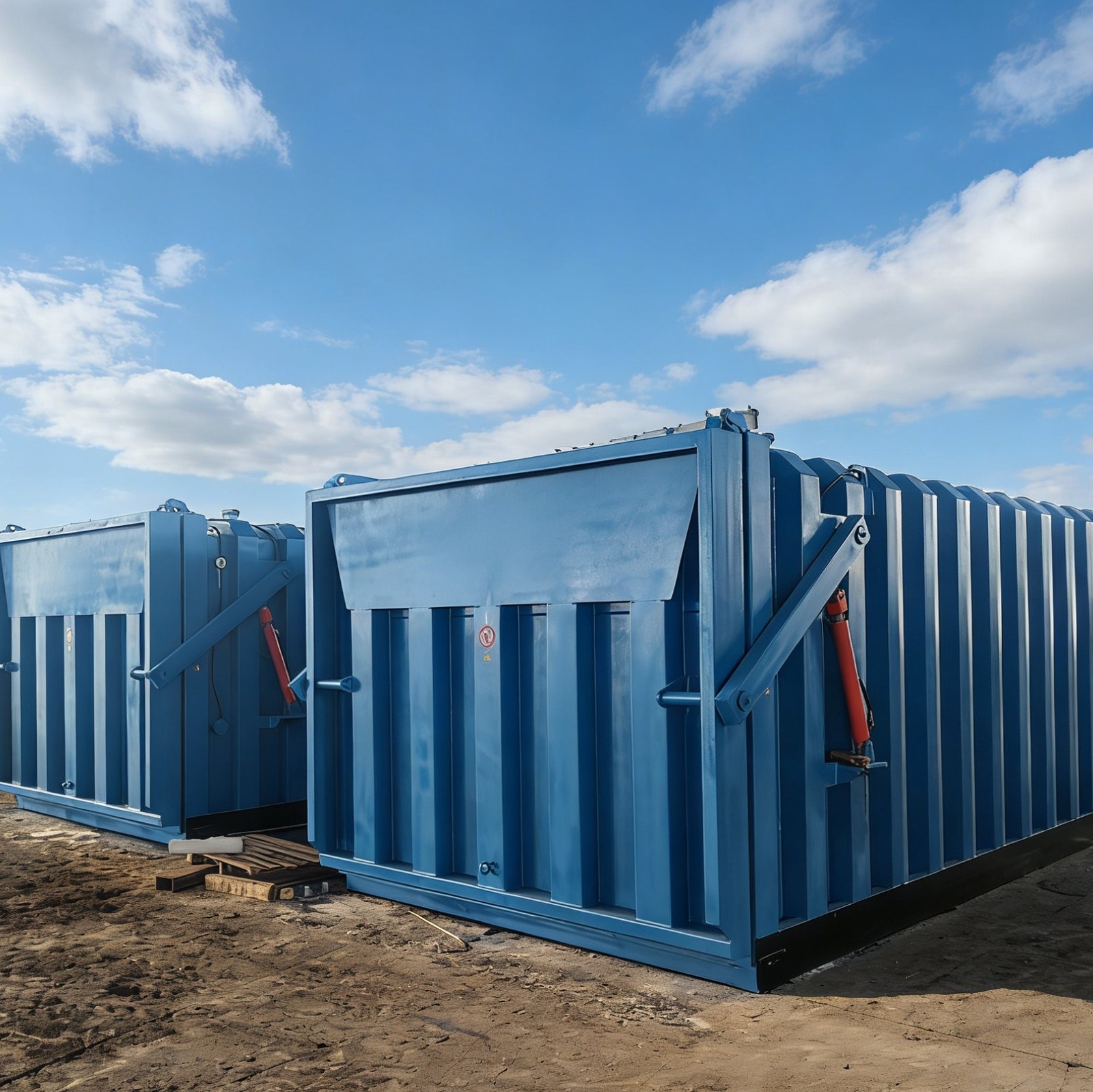 A vacuum precooler chamber positioned outdoors, with a blue enclosure and hydraulic door; the length and width of the chamber directly determine how many rows of pallets can be placed.
7. How to use the two numbers
When you receive a configuration, first calculate kg/m³ against the industry range, then calculate L/kg to see whether it falls within 4~7; then divide total pump power by chamber volume and compare power density with similar proposals. Run through these three numbers, and an inflated proposal basically cannot hide. Conversely, if the customer reports a large batch capacity with bulky packaging (leafy greens, mushrooms), the chamber should be large if it needs to be; at that point the focus is on matching cooling capacity and pump, not forcibly shrinking the chamber.
Specifically for fruit and vegetable precooling and food rapid cooling, the correspondence between chamber form, pallet specifications, and pump set configuration differs: fruit and vegetable vacuum precoolers handle room-temperature fruits and vegetables (fed at 25~30°C), and an oversized chamber mainly affects pre-pumping time; food vacuum rapid coolers handle hot food (fed at 80~90°C) and must also account for the moisture load in the high-temperature stage. For the relationship between pump speed and ultimate vacuum, refer to Vacuum Pump Pumping Speed and Ultimate Vacuum: Which Number Should You Look At.
Give us the product type, packaging method, batch capacity, and site dimensions, and we can size the chamber volume and pump set to the right point based on these three numbers.