Interested in a Similar Solution?
Tell us about your product and capacity — we will prepare a tailored proposal for your application.
Ask About This Solution →The core temperature of soybean products is around 85°C when they come out of the pot. Spreading them out to cool, blowing them with fans, and then moving them into a cold room for slow cooling—this approach shows no problems when daily output is small. But once export orders come in and several batches must go out every day, cooling becomes the bottleneck of the whole line: the front end keeps discharging product, while a pile of product waits to be cooled down.
What this project addresses is exactly this segment: turning cooling from “waiting” into “a process with a fixed rhythm.”
Project Background
The customer is a soybean products processing enterprise in Zhejiang, whose products are mainly for export orders. The workshop organizes production by batch, with a single batch input of around 300 kg.
The original cooling method was natural spreading combined with slow cooling in a cold room, which took up a lot of space, took a long time, and made it difficult to align the rhythm between batches. Export orders place higher demands on batch consistency: after a batch comes out of the pot, it must drop to the same temperature within a predictable time before it can enter subsequent processes and packaging. The customer’s requirement was therefore straightforward—load a batch of product into the equipment, cool it at a fixed rhythm, and what comes out is at a temperature ready for the next step.
On-Site Challenges
Rapid cooling of soybean products has three unavoidable difficulties.
First, high temperature and high humidity. Moisture on the surface of material coming out of the pot at 85°C evaporates in large quantities, instantly creating a high-temperature, high-humidity environment inside the cabinet. Conventional air cooling loses efficiency quickly under such conditions; the cold air mainly carries away surface heat, and the core temperature does not come down.
Second, stacking thickness. A single batch of 300 kg is stacked in layers after being loaded into the cabinet. With heat exchange by air convection, the outer layers are already cold while the inner layers are still hot, and the temperature difference within a batch is hard to converge.
Third, rhythm. Export orders are scheduled for continuous production, so the equipment cannot “start and stop.” The cooling cycle must be stable and predictable; otherwise, both upstream and downstream processes have to wait.
Solution and Configuration
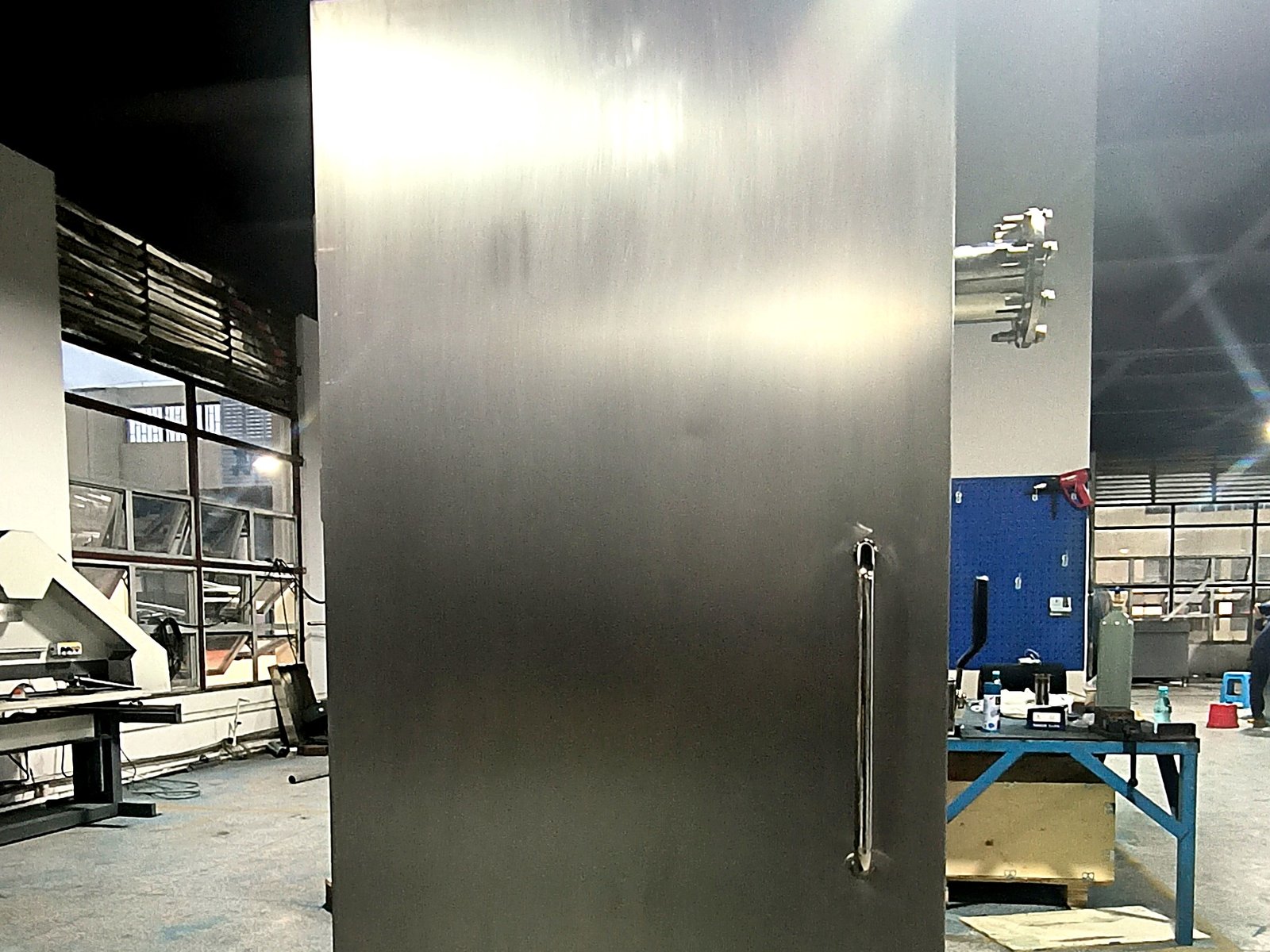
The project uses one CVF-300 food vacuum rapid cooler, with a capacity rating of 300 kg/batch, matching the single-batch input of this project.
| Item | Configuration |
|---|---|
| Equipment model | CVF-300 (300 kg/batch) |
| Material processed | Soybean products |
| Vacuum chamber internal dimensions | L2200 × W1000 × H1800 mm |
| Total cooling capacity | 114.2 kW (98,200 kcal/h) |
| Cooling power | 19.18 kW |
| Refrigeration compressor | Copeland scroll ZB95KQE × 2 |
| Vacuum pump | SV300 × 1 |
| Condensing method | Water-cooled (1 × Lingji CT30 cooling tower, 1 × YLG65-20 water pump) |
| Total power | 27.63 kW |
The working principle is not complicated: after the material is loaded into the sealed vacuum chamber, a vacuum is drawn, the pressure inside the chamber drops, and the boiling point of water falls accordingly. The material’s own moisture boils and vaporizes at low temperature, and the vaporization process continuously carries heat away. Heat is not carried away by blowing air; it moves from inside the material outward, so stacking thickness and placement have far less effect on core temperature, and a batch comes out with uniform temperature.
The water vapor produced by vaporization is condensed into water by the water trap, and the refrigeration system then carries the heat out of the chamber—this is why the cooling capacity in this configuration must be sufficient: if the water-trapping capacity cannot keep up, the vacuum level cannot be maintained, and cooling will “stall” at some temperature midway.
For equipment details, see the food vacuum rapid cooler product page.
In the same project, the customer also equipped a 180 kg/batch fruit and vegetable precooler for post-harvest precooling of items such as bean sprouts: from ambient 25–30°C down to 10°C, with a single cycle of 25–30 minutes, chamber internal dimensions L2200 × W1600 × H1500 mm, total cooling capacity 16.35 kW, fitted with an FNWT-120 air-cooled condenser. Rapid cooling and precooling are two different operating conditions—one is cooling hot food after it comes out of the pot, the other is post-harvest cooling of ambient-temperature agricultural products—so they are configured separately, with parameters set according to each application.
Measured Performance Data
Operating data after the equipment was put into use:
| Indicator | Data |
|---|---|
| Single-batch throughput | 300 kg |
| Processing time per cycle | 15–20 minutes |
| Cooling range | Soybean products 85°C → 7°C |
| Total cooling capacity | 114.2 kW |
| Total power | 27.63 kW |
At this rhythm, multiple batches can be run per shift, and the cooling stage no longer holds up the upstream and downstream processes. The product is cooled inside the sealed chamber throughout, without contact with outside air, and the temperature difference between batches is much smaller than with the spreading method. The measured moisture-loss rate is not stated with specific values in this solution; the order confirmation documents shall prevail.
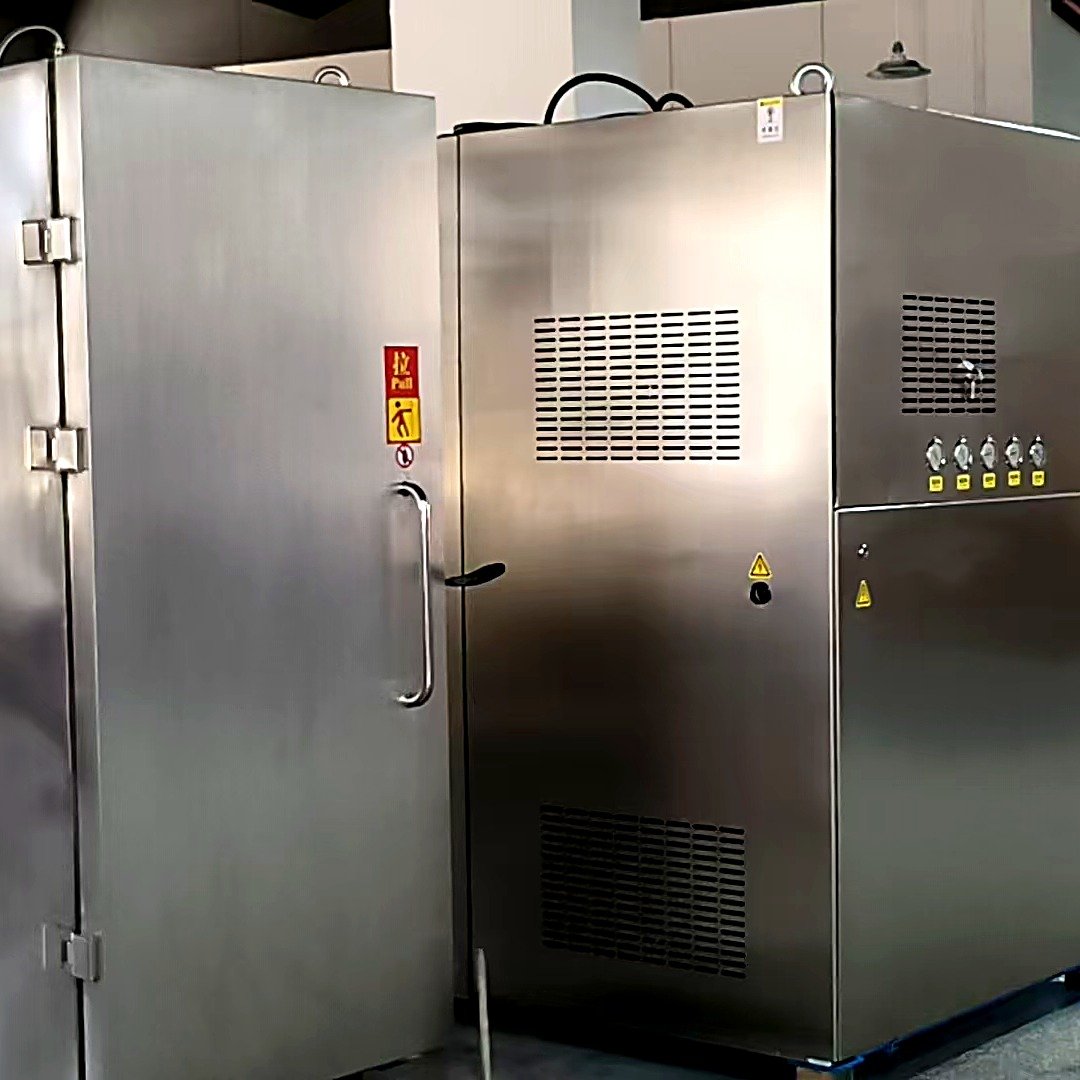
Soybean products are just one example. The same process holds for braised products, cooked foods, central kitchen meal preparation, baking, and prepared dishes; the difference lies in material moisture content, single-batch weight, and end temperature, and the configuration must be calculated according to actual operating conditions. Post-harvest precooling of fruits and vegetables follows another route; see fruit and vegetable vacuum precooler.
Summary
The value of this project is not “how fast it cools,” but that it turns cooling into a process that can be timed: 300 kg per batch, 85°C to 7°C, 15–20 minutes, and the product is ready to move on. For soybean products and cooked food processing plants that take export orders and run tight batch schedules, this segment is often the first place to act.
For similar food factory cooling projects, see our customer case collection. If your material type, single-batch weight, discharge temperature, and required end temperature are close to those of this project, send us these data and we will calculate the configuration according to actual operating conditions—contact us.
Interested in a Similar Solution?
Tell us about your product and capacity — we will prepare a tailored proposal for your application.
Ask About This Solution →