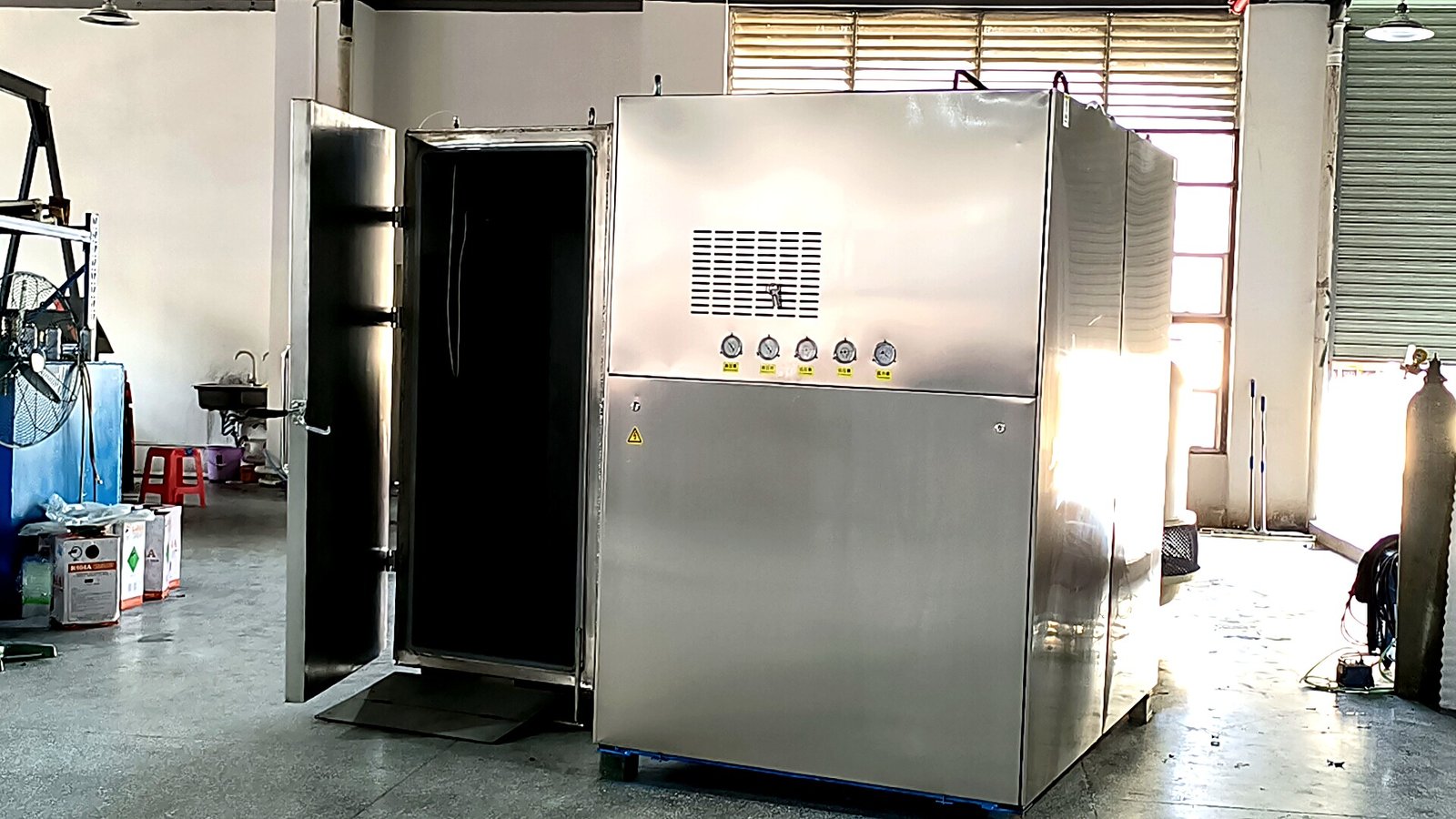
2000 kg Braised Duck from 80°C to 5°C: Vacuum Rapid Cooling Cuts Cooling Time to Half an Hour
A braised food processor uses the CVF-2000 food vacuum rapid cooler to cool 2000 kg of braised duck from 80°C to 5°C in just 25-30 minutes, replacing open-air
Interested in a Similar Solution?
Tell us about your product and capacity — we will prepare a tailored proposal for your application.
Ask About This Solution →Braised deli products: easy to cook, hard to cool. A pot of braised duck comes out at around 80°C. The old method—spreading it on racks, blowing fans over it, then pushing it into a cold store to cool slowly—takes several hours. Once capacity goes up, cooling becomes the bottleneck of the whole line: the stove keeps producing, while products queue up waiting to cool down.
What this project does is turn the cooling stage from “waiting” into a “process step.”
Project Background
The client is a braised deli products processor. Braised duck is one of its main sellers. Previously, cooling was done by natural spreading plus slow cooling in a cold store. After output increased, two problems surfaced at the same time: first, cooling took too long, and products stayed in the 60°C to 10°C range for too long, making microbial risk hard to control; second, spreading took up a lot of floor space, with products waiting to cool all over the workshop and chaotic turnover.
The client’s requirement was straightforward: the whole batch had to be cooled quickly and uniformly to a low temperature, ready to enter the next process step or packaging right after cooling, with no more manual turning or waiting.
Site Challenges
Cooling braised duck has two unavoidable difficulties.
The first is high temperature and heavy moisture. Freshly cooked products carry a large amount of evaporating moisture, creating a high-temperature, high-humidity environment inside the chamber. Ordinary cooling equipment loses efficiency quickly under such conditions.
The second is large batch size and thick pieces. A single batch is prepared at 2000 kg. After products are stacked, the core cools noticeably slower than the surface. If cold air is blown at them forcefully, the surface is often already cold while the core has not reached temperature, and batch consistency cannot be guaranteed.
The client also set a hard requirement: the equipment had to run continuously in step with the rhythm of the upstream and downstream processes, not start and stop.
Solution and Configuration
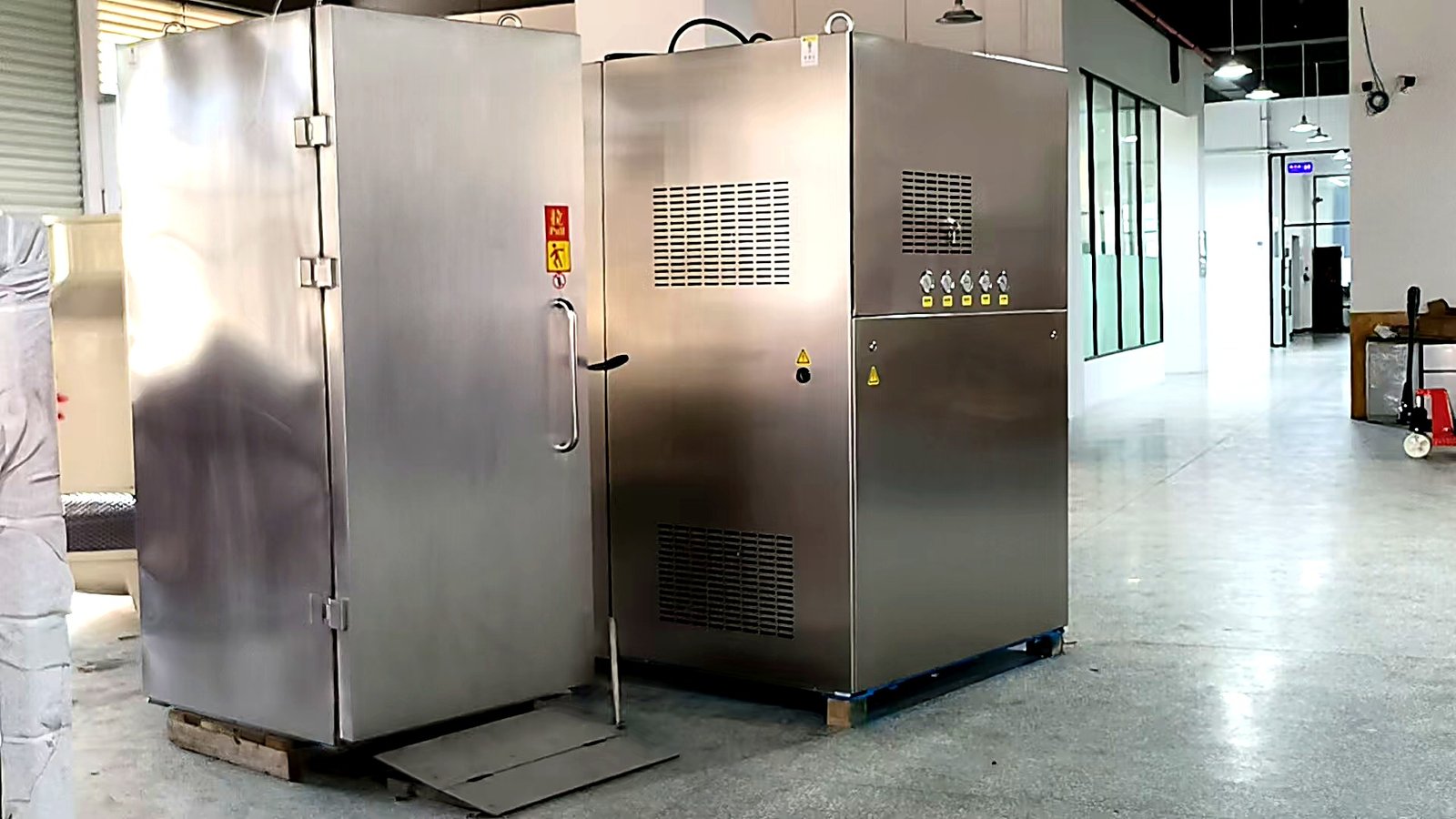
The solution uses one CVF-2000 food vacuum rapid cooler (capacity rating 2000 kg/batch) for a single batch of 2000 kg.
Core configuration:
| Item | Configuration |
|---|---|
| Equipment model | CVF-2000 (2000 kg/batch) |
| Vacuum chamber internal volume | 9.5 m³ (internal L3450 × W1450 × H1900 mm) |
| Ultimate vacuum | ≤ 600 Pa |
| Primary water catcher cooling capacity | 320 kW |
| Refrigeration compressor | Bitzer screw compressor, 56 kW |
| Vacuum pump | Leybold SV300 × 2, 11 kW |
| Condensing method | Water-cooled (with cooling tower and water pump 7.7 kW) |
| Operating power | 74.7 kW |
| Power supply | 3P-380V-50Hz |
| Equipment weight | 12500 kg (main unit dimensions L3500 × W2250 × H2520 mm, excluding cooling tower) |
The system works as follows: after products are loaded into the sealed vacuum chamber, the pressure inside is reduced to below 600 Pa, which sharply lowers the boiling point of water. The product’s own moisture boils and vaporizes at low temperature, and the vaporization process continuously carries heat away—cooling proceeds from the inside of the product outward, without relying on air convection, so thick pieces and dense stacking do not affect core temperature.
The key is where the water vapor goes. The water vapor vaporized inside the chamber is condensed into water by the water catcher, and the refrigeration system then carries the heat out of the equipment. The water catcher is a prerequisite for this process: only after it captures the water vapor can the vacuum pump keep maintaining the pressure, so the chamber does not lose pressure due to accumulated vapor.
Detailed product and configuration information can be found on the food vacuum rapid cooler product page.
Measured Results
Operating data after the equipment was put into use:
- Single batch capacity: 2000 kg;
- Processing time per cycle: 25–30 minutes;
- Cooling range: braised duck from 80°C down to 5°C;
- Operating power: 74.7 kW.
At this pace, multiple cycles can be run per day, and the cooling stage no longer holds up the entire line. Products are cooled inside the sealed vacuum chamber, isolated from outside air throughout, with uniform output temperature and much smaller batch-to-batch variation than with the spreading method.
Beyond braised products, the same process is also used in central kitchens, baking, and prepared dishes—applications that require “hot out of the pot, fast cooling.” The specific configuration is determined by product type, single batch weight, and end-point temperature.
Summary
In this braised duck case, vacuum rapid cooling does not solve “cooling a bit faster”—it turns cooling into a controllable, timeable process step: 2000 kg per batch, from 80°C down to 5°C in 25–30 minutes, ready to move on as soon as it is cold. For deli processors whose capacity has increased and who can no longer keep up with spreading and cold stores, this is the stage most worth addressing first.
For similar food factory cooling cases, see our customer case collection. If your product temperature range and single batch weight are close to this project, you can send us the product type, single batch weight, out-of-pot temperature, and required end-point temperature, and we will calculate the configuration based on actual operating conditions—contact us.
Interested in a Similar Solution?
Tell us about your product and capacity — we will prepare a tailored proposal for your application.
Ask About This Solution →