A water ring pump's lowest achievable pressure is not determined by the machining precision of the pump, but by the temperature of the working water. Once the pressure drops to the saturated vapor pressure corresponding to the water temperature, the liquid ring inside the pump begins to vaporize on its own, the water film can no longer seal, and the pumping speed falls to zero. Most of the summer site reports of "longer cycles, pump not broken" come down to this one point.
On a food vacuum rapid cooler it is responsible for only one stage: the first few minutes after 90°C hot food enters the chamber, when the evaporation rate is concentrated, pulling the material from 90°C down to about 50°C. After that, the work is handed over to the water catcher and the rotary vane pump.
Its role on the rapid cooler
The CVF-600W as actually delivered (600 kg per batch, 3.2 m³ chamber) is fitted with a 2BV5131 water ring pump (11 kW), running from 0 to 5 minutes to bring the material from 90°C down to 50°C; a 300-type rotary vane pump (7.5 kW) then works with the YXEV-20 water catcher to take it from 50°C to 15°C, with the whole batch taking 18–22 minutes.
The reason this stage does not use the rotary vane pump directly is that the water vapor load from 90°C material is concentrated; entering the rotary vane pump chamber it is absorbed by the pump oil, the oil quickly turns milky, and the pumping speed drops. The water ring pump uses water as its piston, has no oil, and water vapor entering it simply adds to the water. The cost is that it needs an extra water circuit, and its pumping speed is constrained by water temperature.
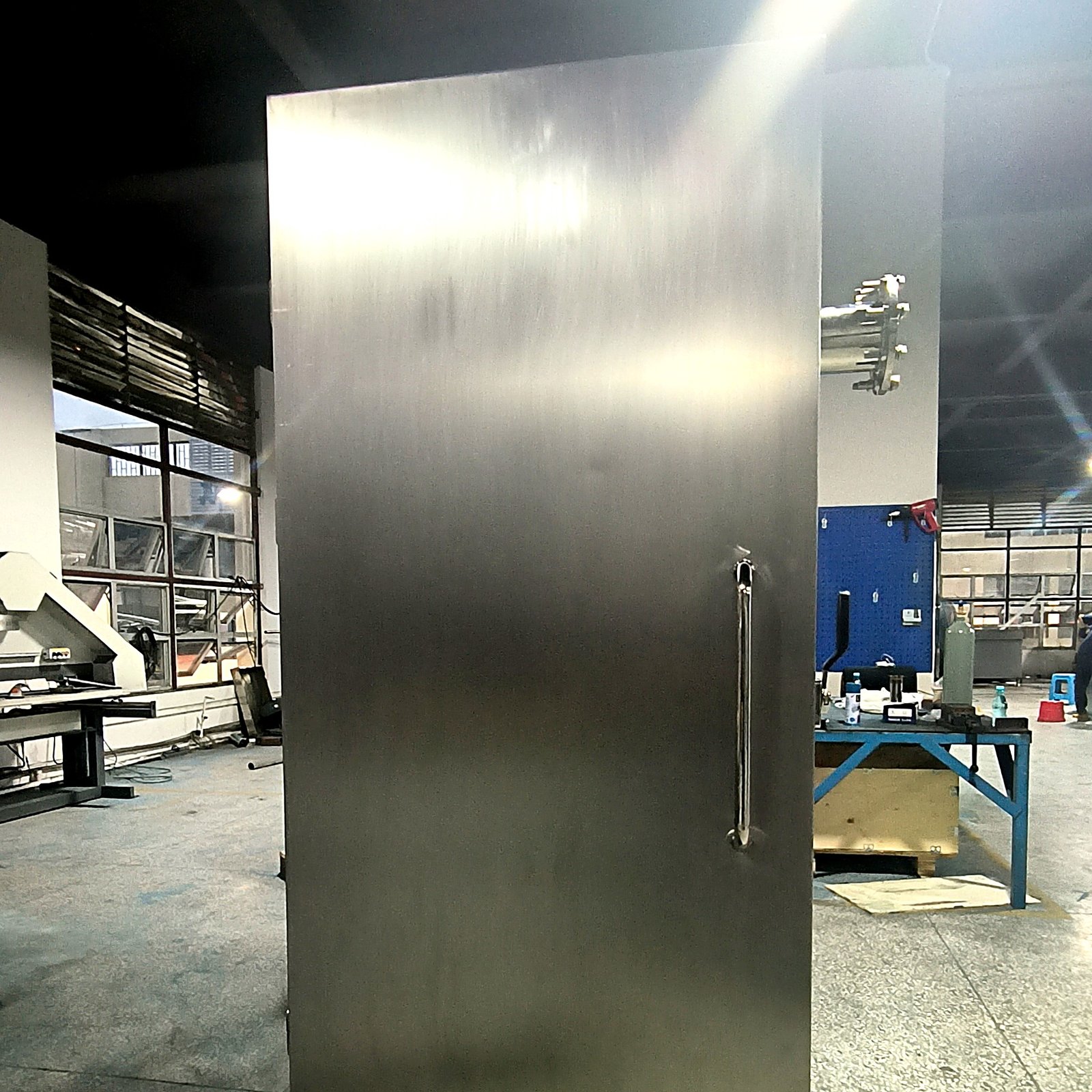 Food vacuum rapid cooler chamber, stainless steel door with full-length handle (Thailand cooked food project, before shipment in August 2026)
Water temperature sets its floor
The ultimate pressure of a water ring pump is the saturated vapor pressure corresponding to the working water temperature. This relationship can be looked up directly:
| Working water temperature | Saturated vapor pressure of water | Range that cannot be pumped at this water temperature |
|---|---|---|
| 10°C | 1.23 kPa | below 1.2 kPa |
| 15°C | 1.71 kPa | below 1.7 kPa |
| 20°C | 2.34 kPa | below 2.3 kPa |
| 25°C | 3.17 kPa | below 3.2 kPa |
| 30°C | 4.25 kPa | below 4.2 kPa |
| 35°C | 5.63 kPa | below 5.6 kPa |
| 40°C | 7.38 kPa | below 7.4 kPa |
This table explains two things.
First, why the switchover point is set at 10 kPa. 10 kPa corresponds to a water saturation temperature of about 45.8°C; the material has just dropped to 45–50°C at this point, and the water ring pump cannot hold the pressure any lower, so it is handed over to the water catcher and rotary vane pump, which fits the process. The two pump stages are a parallel arrangement, and the piping sequence must not be reversed; this is covered in Configuration logic of two-stage cooling.
Second, why cycles get longer in summer. At sites where the cooling tower supplies 32/37°C water, the working water runs at 30–35°C, the water ring pump's floor rises to 4–6 kPa, and the roughing stage has to run one or two minutes longer. This is not a pump fault; the water temperature has gone up. To keep the roughing stage stable, feed the pump with cooling tower supply water, do not circulate the return water directly, and maintain a continuous supply of fresh cooling water. For a 600 kg class project the make-up water is about 2.0 m³/h (single-stage water ring pump, such as 2BV5061).
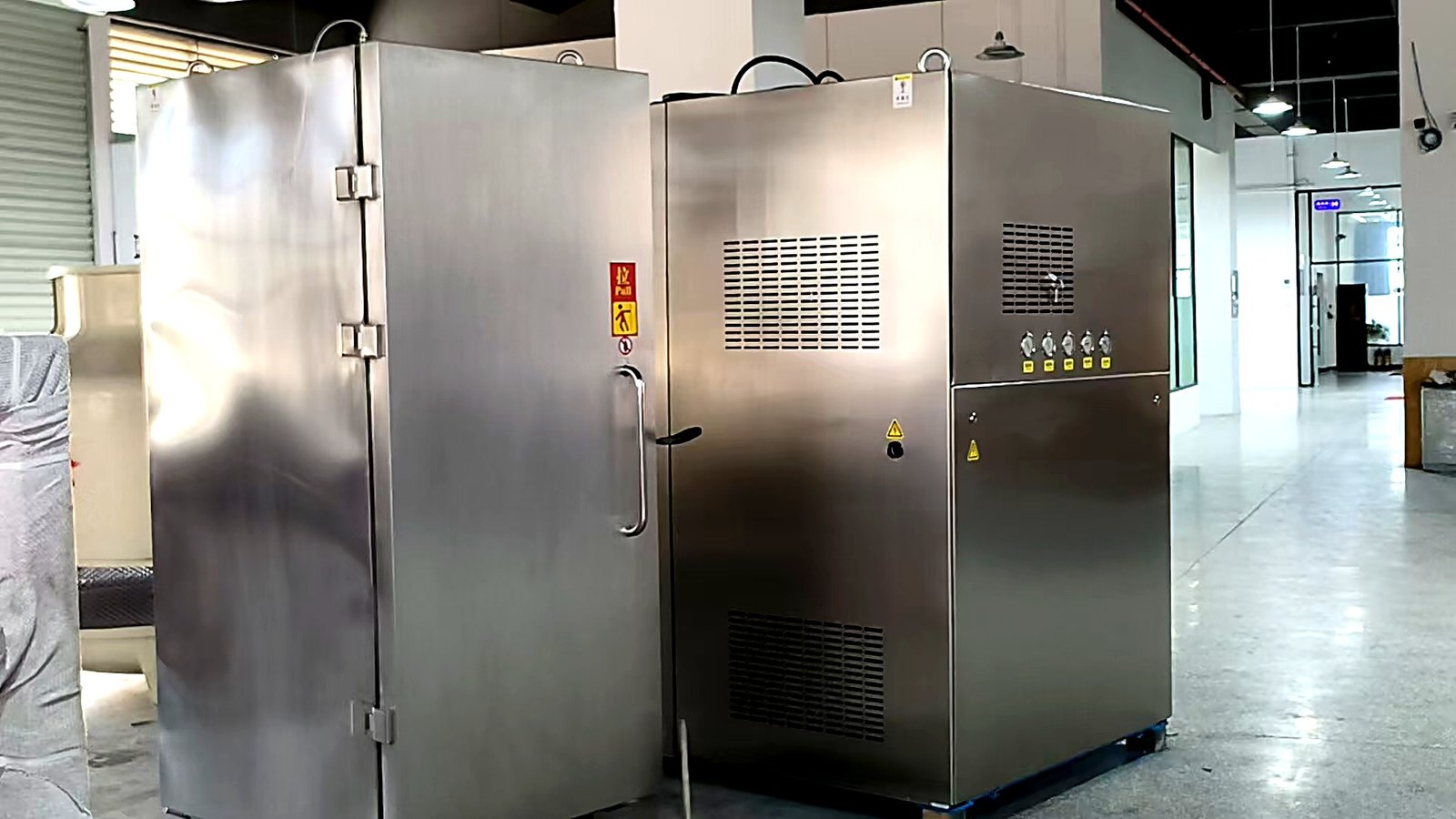 Two rapid cooler chambers side by side, with the cabinet with cooling louvers and control panel on the right (same project)
Four types of site problems, all related to water
Water shortage, water cut-off. The liquid ring cannot be established, the pump runs dry, pumping speed is close to zero, and the end faces wear. The start-up sequence must be written into the operating procedure: water on first, then start the pump.
Scaling. Hard water scales up the clearance between the impeller and the pump casing; the clearance grows and the pumping speed falls year after year. Customers usually describe it as "after two or three years, the same chamber takes longer and longer to pump down"; leak detection finds nothing, and only on opening the pump is the scale visible. The remedy is softened water, or periodic cleaning according to water quality.
Cavitation. Forcing a water ring pump down to near the saturation vapor pressure of the water temperature causes local vaporization of the liquid ring, a crackling noise inside the pump, and pitting of the impeller. The roughing stage of a rapid cooler runs at high temperature and does not normally reach this; pulling below 2 kPa with it will.
Winter freezing and cracking. The water in a water ring pump is once-through. When the ambient temperature is below 0°C and the pump is stopped for more than 1 hour, the water inside the pump must be drained. At northern projects where the pump is stopped without draining, cracked casings and impellers are a common cause of repair returns.
There is also the shutdown sequence: after the water ring pump stops, the liquid ring falls back and water in the piping can be sucked back. Fit a pneumatic valve or butterfly valve at the pump inlet; close the valve first, then break the vacuum. For the routine maintenance schedule see Vacuum cooling equipment maintenance guide.
Two situations where a water ring pump should not be used
Where the site has neither a water supply nor drainage, a water tank must be added for circulation, and operating and maintenance effort goes up accordingly; where long-term vacuum holding is required and water must not flow back when the pump stops, the water ring pump is not a holding pump.
Conversely, a fruit and vegetable vacuum precooler loads at ambient temperature with a small water vapor load, and the standard configuration uses a rotary vane pump directly, with no water ring pump. This is one of the dividing lines between precoolers and rapid coolers on the vacuum side; confirming this point at the selection stage can save a whole water circuit. For configurations of rapid coolers by batch size see Food vacuum rapid cooler.