What freshness-preservation certifications must exported fruits and vegetables pass? How does origin precooling fit in
For exported fruits and vegetables, the core of freshness-preservation certification is providing the destination country with a “temperature evidence chain.” The EU requires CE machinery safety plus food-contact compliance, the US requires FDA, Russia requires EAC, and Japan requires JIS plus phytosanitary inspection. Whichever certificate is involved, all require that postharvest temperatures can be lowered quickly: vacuum precoolers can reduce fruits and vegetables from 25–30°C in the field to 0–10°C within 20–30 minutes, with batch capacities from 500kg to 16000kg. Vacuum-Fresh export model CVF-5000-10P processes 5000–6500kg per batch and completes precooling in 20–30 minutes; a Hungary project achieved 16 tons/batch. Only when the temperature can be lowered does shelf life withstand sea and air freight cycles, and only then is there data for certification audits to verify.
What exactly do freshness-preservation certifications for exported fruits and vegetables certify
Many people think export certification is just a certificate, but it is not. Agricultural product exports must pass three layers of requirements:
| Layer | Content | Common requirements |
|---|---|---|
| Destination country market access threshold | Phytosanitary + food regulations | EU EU 1935/2004 food contact, US FDA 21 CFR 177, Japan Plant Protection Act |
| Process management standards | Good Agricultural Practices + cold-chain traceability | GLOBALG.A.P., HACCP, traceable temperature records |
| Commercial contract requirements | Customer-specified | Supermarket inspection, third-party test reports (SGS/BV) |
| The same applies to equipment exports. Vacuum precoolers sold to the EU require CE (three documents: Machinery Directive MD 2006/42/EC, Low Voltage Directive LVD, and Electromagnetic Compatibility EMC), sold to Russia require EAC (lead time 2–4 months), and sold to Saudi Arabia require SABER. Vacuum-Fresh’s practice for export projects is to list a separate “Certification and Documents” column in the quotation, stating what is included and what is not, and to configure electricals according to the destination country’s voltage and frequency—France 400V/50Hz, Vietnam 380V/50Hz, India 415V/50Hz. |
Why freshness-preservation certification hinges on temperature
Fruits and vegetables continue to respire after harvest, and respiration heat keeps raising their temperature. Left at room temperature for half a day, leafy vegetables lose water and wilt, and berries begin to soften and rot. For every 10°C increase in temperature, respiration intensity roughly doubles, and shelf life shrinks accordingly. During freshness-preservation certification audits, inspectors look at temperature records: How long after harvest did the produce enter precooling? To what temperature was it precooled? Were there any breakpoints in the full cold-chain temperature? Without a precooling step, one cell on the record sheet remains blank, and the shipment may be rejected at the port of arrival. Vacuum precooling solves the two words “fast” and “even.” Water evaporates under low pressure and carries away heat, cooling the core and leaves together, unlike cold-room precooling where the outer layer is cool but the core is still warm. In actual projects, leafy vegetables are cooled from 25–30°C to 0–10°C in 20–30 minutes, with water loss controlled at 1–2%.
How three real export projects were handled
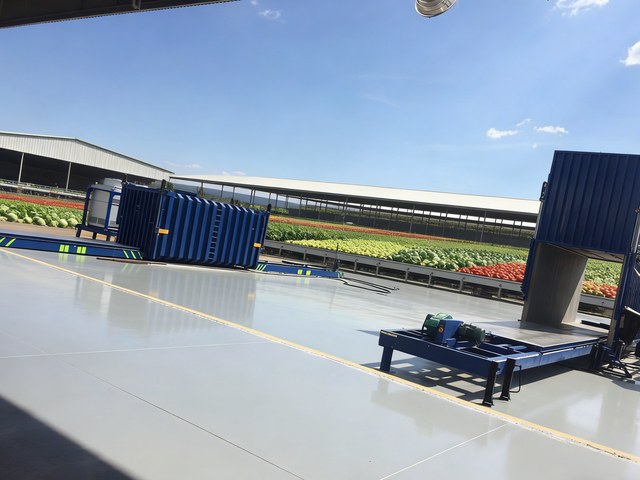
Russia CVF-5000-10P The Russian market requires EAC certification, and vegetables are subject to Russian phytosanitary inspection upon arrival at port. This ten-pallet precooler was configured as follows:
| Parameter | Value |
|---|---|
| Capacity per cycle | 5000–6500kg |
| Processing time | 20–30 minutes |
| Final temperature | 0–10°C |
| Refrigeration capacity | 406kW (349000kcal/h) |
| Compressor | Bitzer, 158.4kW |
| Vacuum pump | Leybold SV0300B, six units, 33kW |
| Chamber volume | 39.3m³ |
| Ultimate vacuum | ≤600Pa |
| Power supply | 380V/50Hz/3P |
| 16-pallet 16-ton precooler | |
| European projects have clear restrictions on refrigerants. This unit uses R134a refrigerant, with a total refrigeration capacity of 1200kW, six Bitzer CSH8593-180Y-38P compressors plus four Leybold SV630 vacuum pumps, processing 16 tons per batch. For the EU market, food-contact materials are checked under EU 1935/2004; material certificates must be complete for components that directly contact food, such as chamber liners, trays, and sealing rings. | |
| Netherlands flower precooling CVF-3000 | |
| Flower exports are somewhat different from fruits and vegetables; they go through auction markets and require high temperature uniformity after precooling. This CVF-3000 processes 3000kg per batch, cools to 0–5°C in 20–30 minutes, has a refrigeration capacity of 231kW, and uses three Bitzer 6F-40.2Y compressors and six Leybold SV300B vacuum pumps. |
Four operational points for exporters configuring precooling
- Ask the destination country first, then decide the plan: Russia requires EAC, the EU requires CE plus food-contact compliance, and the US requires UL plus FDA. Work the certification cycle backward into the delivery schedule; don’t wait until the goods are built to discover the certificate has not been obtained.
- Follow the destination country for voltage and frequency: France 400V/50Hz, Vietnam 380V/50Hz, India 415V/50Hz; localize nameplates and manuals into the local language.
- Keep material certificates for food-contact components: Stainless steel 304/316 is basically fine, but rubber seals and plastic parts require material declarations.
- Turn temperature records into an evidence chain: Automatically record the precooler’s in-feed and out-feed temperatures and times, and export them for inspectors; this is more effective than verbal explanations. If the origin end does not yet have precooling capability, you can start with a small machine processing 500kg to 2000kg per batch, equipped with 1–4 pallets, first securing the 4-hour postharvest golden window, and then expand to ten pallets or sixteen pallets according to export volume. Vacuum-Fresh’s fruit and vegetable vacuum precooler covers the full range from 500kg to 16000kg/batch, with configurations adjusted according to the destination country’s power supply and certification requirements; export projects can be directly supported.
FAQ
What temperature is suitable for precooling exported fruits and vegetables? Most leafy vegetables and berries are precooled to 0–10°C, depending on the variety. Cauliflower and broccoli are recommended at 0–5°C; tropical fruits must not go below 10°C to prevent chilling injury. Does vacuum precooling cause water loss? Yes, but it is controllable. Under normal configurations, water loss is 1–2%, lower than cold-room precooling. For leafy vegetables, it can be further controlled by misting to replenish water. Can precoolers pass CE certification? Full-machine CE requires three documents: technical file (drawings plus calculations), risk assessment, and Declaration of Conformity DoC. Purchased compressors, vacuum pumps, and electrical controls must have original-manufacturer CE declarations before full-machine CE can be completed.
Are small vacuum precoolers suitable for export projects? They are suitable as a starting point. 1–4 pallet models process 500–2000kg per batch, making them suitable for cooperatives and purchasing stations to first establish precooling capacity, then expand capacity after getting the export process running smoothly. What special considerations are there for the Russian market? The EAC certification cycle is 2–4 months, longer than the production cycle, so it must be arranged in advance. Also confirm the payment collection path; sanctions affect settlement methods.
Author: Yuanxian Mechanical Engineering Department | 2026-08-22