Interested in a Similar Solution?
Tell us about your product and capacity — we will prepare a tailored proposal for your application.
Ask About This Solution →When a food factory asks about vacuum cooling, they usually want three things: faster throughput, better food safety, and longer shelf life. Theory says vacuum cooling delivers all three. But the real question is — does it work across different food types?
Short answer: yes, and the data proves it.
Here are three real application cases from our food vacuum cooler installations — braised meat, central kitchen, and export pastries.
Case 1: Braised Meat — Shangpin Gong’e
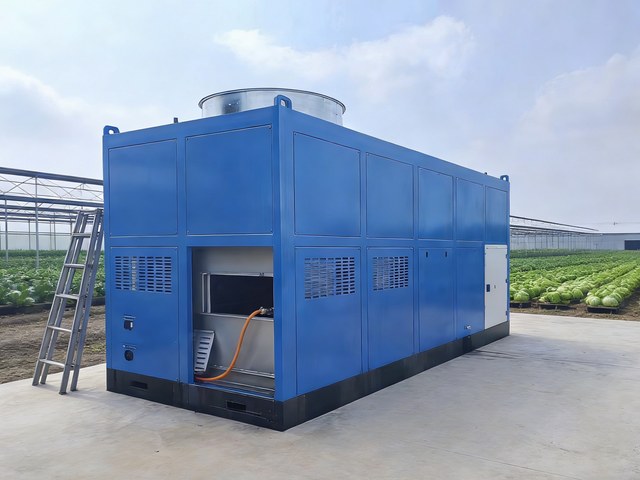
Equipment: CVF-150 Food Vacuum Cooler Location: Hefei, China Product: Seasoned braised goose (whole birds)
The Problem
Shangpin Gong’e produces 150kg of braised goose per batch. Cooked goose exits the pot at 90–95°C. Before vacuum cooling, they used a positive-pressure cold room at 2°C. Cooling from 90°C to 10°C took 4+ hours. That meant:
- The production floor could only run one batch per shift
- Bacteria had a 4-hour window at ideal growth temperature (30–60°C)
- The goose surface dried out from prolonged air exposure
The Solution
A single CVF-150 with Copeland ZB58KQ compressor (7.2kW), Leybold vacuum pump (2.2kW), and 5.8m² stainless steel vapor condenser (cold trap).
The Results
| Metric | Before (Blast Chiller) | After (CVF-150) | Improvement |
|---|---|---|---|
| 90°C → 10°C | 4 hours | 22 minutes | 11× faster |
| Batch throughput | 1 per shift | 3 per shift | 3× increase |
| Surface moisture loss | ~5% (air drying) | ~2% (vacuum) | 60% less weight loss |
| Shelf life | 3 days refrigerated | 5 days refrigerated | +2 days |
The key insight: vacuum cooling doesn’t just speed up cooling. By passing through the 30–60°C danger zone in under 5 minutes instead of 90 minutes, it dramatically reduces bacterial growth. Shangpin Gong’e now runs three batches per shift with the same labor cost.
Case 2: Central Kitchen — Juyuan Chudao
Equipment: CVF-200 (configured as CVF-100 processing capacity) Location: Guangzhou, China Product: Pre-cooked pork dishes, braised tofu, vegetable mixes for restaurant chain distribution
The Problem
Juyuan Chudao supplies 18 restaurant locations from a single central kitchen. They needed to:
- Cool cooked dishes from 85°C to 10°C within food safety regulations (China GB 19295 requires ≤2 hours through danger zone)
- Process multiple SKUs in the same shift
- Fit into limited floor space
The Solution
A CVF-200 with dual chambers (configured to process 100kg per batch in each), Copeland ZB58KQ compressor, UCW010A water-cooled condenser, and YXEV-7 vapor condenser.
The Results
| Metric | Requirement | Achieved | Status |
|---|---|---|---|
| Cooling time (85°C → 10°C) | ≤2 hours | 18–25 minutes | ✅ Pass |
| Batch size | 100kg/cycle | 100–120kg | ✅ Pass |
| Cycles per shift | 3 | 6–8 (dual chamber alternating) | 2.5× capacity |
| Core temp uniformity | ±3°C | ±1.5°C | 2× better |
“We went from two shifts to one shift at the same output. The industrial food cooler paid for itself in labor savings alone.” — Production Manager, Juyuan Chudao
Case 3: Export Bakery Pastries — France
Equipment: CVF-160 Food Vacuum Cooler Location: France Product: Artisan puff pastry, croissant dough, laminated dough for export
The Problem
A French patisserie supplier needed to cool laminated dough blocks from 80°C to 4°C after baking, before freezing. Conventional blast freezing took 3+ hours and caused:
- Surface crust cracking from uneven cooling
- Butter separation in the laminated structure
- Production bottleneck during peak output
The Solution
CVF-160 with ZB114KQE scroll compressor (R404A refrigerant), 12m² vapor condenser, UCW020A water-cooled condenser.
The Results
| Parameter | Before | After |
|---|---|---|
| Cooling time 80°C → 4°C | 3.5 hours (blast freezer) | 16 minutes (vacuum cooler) |
| Butter separation rate | 8% rejection | 0.5% rejection |
| Surface cracking | Frequent | None |
| Export shelf life (frozen) | 6 months | 12 months |
The French case is interesting because it’s not just about speed — it’s about quality. Vacuum cooling removes heat uniformly from the entire mass, not just the surface. The dough cools from inside and outside simultaneously. No steep temperature gradient means no thermal stress cracking.
The Common Pattern
Across all three cases, the same pattern emerges:
- Cooling time drops from hours to minutes — 20–25 minutes is typical
- Product quality improves — less moisture loss, better texture, fewer rejects
- Throughput doubles or triples — same labor, more output
- The engineering is consistent — scroll compressor (Copeland/Bitzer), Leybold vacuum pump, plate-type vapor condenser, LS electric controls
Dongguan Yuanxian Food Machinery Co., Ltd. | vacuum-fresh.com
Interested in a Similar Solution?
Tell us about your product and capacity — we will prepare a tailored proposal for your application.
Ask About This Solution →