5 Real Problems in Industrial Food Cooling — And How Vacuum Cooling Technology Solves Every One
Problem 1: Core Temperature Drops Too Slowly
Conventional blast chilling or cold-room cooling cools the surface fast but leaves the center hot. For 10 kg of cooked meat going from 90°C to 10°C, blast chilling takes 3–5 hours. During this entire window, the product sits in the temperature range where bacteria multiply most rapidly.
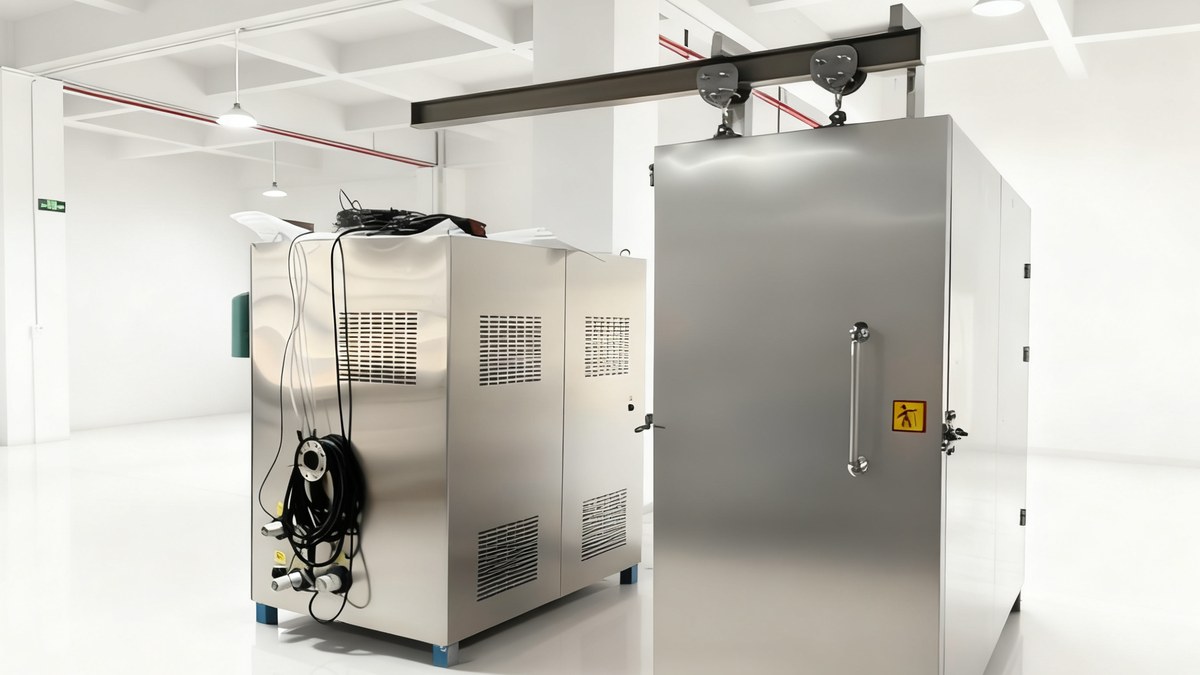
Yuanxian CVF-300 Food Vacuum Cooler takes just 18–22 minutes to cool 300 kg of cooked meat from 90°C to 10°C — and the entire batch cools simultaneously, not from the surface inward.
Engineering principle: At an absolute pressure of 600 Pa, water begins to boil at 5–7°C. Each gram of vaporization absorbs approximately 2,500 joules of latent heat. For 300 kg of product, evaporative moisture release delivers 6–8 kW of refrigeration power — no cold air circulation needed.
Problem 2: Surface Dehydration and Weight Loss
Cold-room cooling causes 3–8% surface moisture loss on cooked foods. For a central kitchen producing 5 tonnes of cooked food per day, a 3% loss means 150 kg of lost product value every day.
Vacuum cooling controls moisture loss between 1–3% (3–5% for baked goods). The reason: cooling happens fast enough that evaporation stops the moment the target temperature is reached. The CVF series reaches a working vacuum of ≤660 Pa within 3 minutes.
Problem 3: The Bacterial Danger Zone Window
Food safety regulations (FDA, EU, GB standards) require cooked food to pass through the 60°C–10°C danger zone within 2 hours. Clostridium perfringens doubles every 20 minutes in the 30–50°C range.
Blast chilling takes 90 minutes to cross the danger zone — allowing 4–5 bacterial divisions. The CVF Food Vacuum Cooler crosses it in just 8–12 minutes — less than one division cycle. By the time food enters the cold chain, its microbial profile is stable.
This is why central kitchens and prepared-meal factories — both domestic and overseas — are increasingly specifying vacuum cooling. It’s not speed for speed’s sake; it’s about building enough safety margin into food safety compliance.
Problem 4: Cold Chain Gaps in Hot Climates
In Southeast Asia, the Middle East, and parts of South America, ambient temperatures exceed 35°C year-round. Traditional cooling takes 3–5 hours; product may still be at 60°C when it leaves the workshop, and it could be past midnight before cold-chain temperature is reached.
Vacuum cooling closes this gap. The CVF-6000 Fruit & Vegetable Vacuum Pre-Cooler (6,000 kg single batch) finishes cooling in 30–50 minutes, with product cores at 4–8°C entering cold storage. The cold chain starts the moment the product leaves the production line.
Problem 5: Misdiagnosing Equipment Faults
This is the most common issue we see in the field. An operator reports, “the vacuum cooler is 40 minutes slower than last week” — and the first instinct is almost always wrong.
The correct troubleshooting sequence:
- Door seal aging — Rubber compression fatigue is the #1 cause. Test: close the door on a piece of paper. If you can pull it out, the seal has failed.
- Valve seal wear — After thousands of cycles, pneumatic or manual valve seals degrade.
- Chamber weld leaks — Rare, but possible after years of thermal cycling.
No major overhaul needed. Door seals and valve seals are field-replaceable wear parts. Diagnosis is simple: close the chamber, start the vacuum pump, stop it, and measure pressure rise. A rise exceeding 50 Pa per minute indicates a leak.
Field-proven: Yuanxian’s fruit & vegetable vacuum pre-coolers and food vacuum coolers use Bitzer compressors and Leybold vacuum pumps — reliable hardware. Replacing seals every 6 months prevents 90% of performance complaints.
Data Comparison
| Parameter | Conventional Cooling | Vacuum Cooling (CVF Series) |
|---|---|---|
| Core temp 90°C→10°C | 3–5 hours | 10–25 minutes |
| Moisture loss (cooked food) | 3–8% | 2–4% |
| Danger zone crossing time | 60–120 minutes | 8–12 minutes |
| Equipment troubleshooting | Often misdiagnosed | Door seal → Valve → Weld |
| Cold chain start point | Delayed 3–5 hours | Immediate |
Data source: Yuanxian Mechanical field operating records, 2020–2026. Actual data varies by product type and batch size. For process simulation tailored to your specific product, contact our technical team.
This article is part of our Industry Insight series. Learn more about vacuum cooling technology →
This page is part of our wider refrigeration work. Two related companies may be useful: Kunning Cryo makes low-temperature freezing and quick-freeze equipment, while Yuanxian Machinery handles our vacuum cooling projects in Chinese.