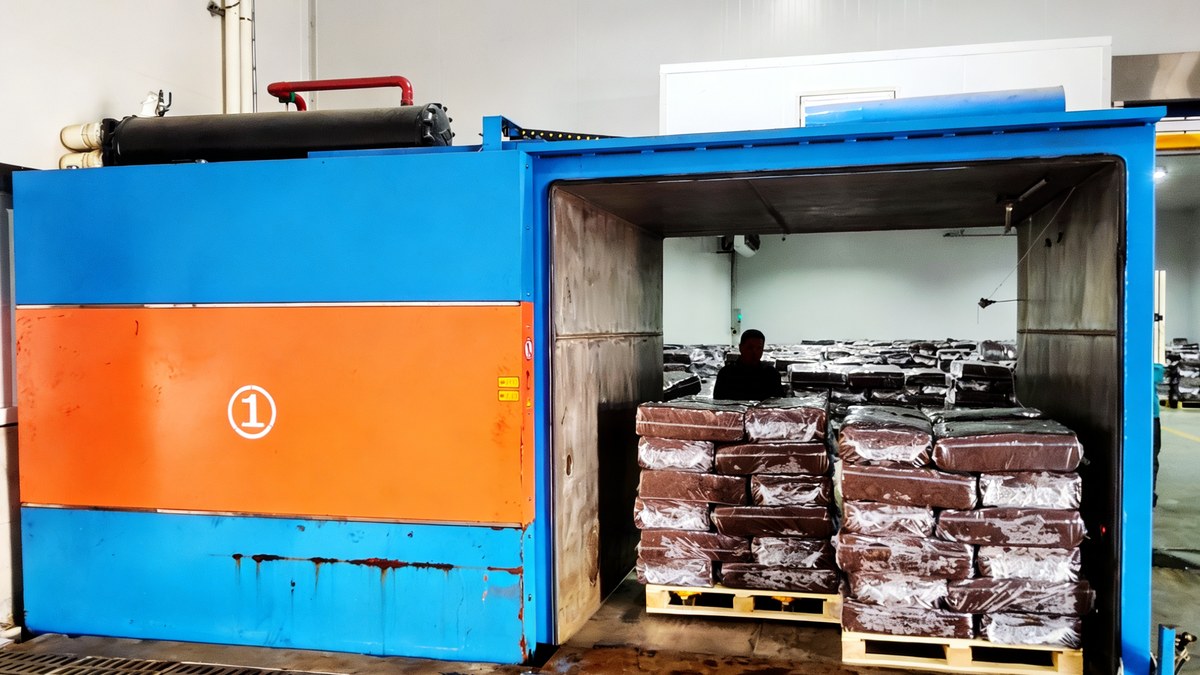
Both use “vacuum.” Both cool things down. But freeze dryers and vacuum coolers are two completely different machines — thermodynamic path, core components, target output, application scenarios: nothing is the same.
The Thermodynamic Root Difference
A freeze dryer works on a solid→gas (sublimation) path: the material is frozen first, then ice turns directly to vapor under vacuum and is removed. The goal is removing 95–99% of moisture.
A vacuum cooler works on liquid cooling (sensible heat transfer): the material does not freeze. Surface moisture evaporates under vacuum, carrying heat away. The goal is dropping temperature from 90°C to 4°C.
This is a fundamental thermodynamic difference — independent of brand or model.
Six Core Engineering Differences
| Parameter | Freeze Dryer (CVD) | Food Vacuum Cooler (CVF) | Vegetable Vacuum Cooler (CVF) |
|---|---|---|---|
| Thermodynamic path | Solid → gas (sublimation) | Liquid cooling (sensible heat) | Liquid cooling (sensible heat) |
| Core objective | Dehydrate 95–99% | Cool 90→4°C | Cool 30→2°C |
| Vacuum level | 13–26 Pa (high vacuum) | ≤660 Pa (rough vacuum) | ≤660 Pa (rough vacuum) |
| Temperature range | -55°C to +120°C (very wide) | 0–10°C | 0–10°C |
| Cycle time | 12–24 hours | 10–25 minutes | 30–50 minutes |
| Heating system | Yes (shelf heating to +80°C) | No | No |
| Cold trap temperature | -35°C to -65°C | -5°C to 0°C | -5°C to 0°C |
The key difference is vacuum level: freeze dryers (13 Pa) operate at 50× higher vacuum than coolers (660 Pa). This means completely different pump configurations, sealing requirements, and leak tolerance.
Why People Confuse Them
Both machines look similar — vacuum chamber, vacuum pump, refrigeration system, cold trap. But the engineering parameters are completely different:
Vacuum Pumps
| Equipment | Pump Configuration | Typical Model |
|---|---|---|
| Vegetable vacuum cooler | Single-stage rotary vane | 1× Leybold SV300B |
| Food vacuum cooler | Single-stage + water ring | 1× Leybold SV100 |
| Freeze dryer | Two-stage: rotary vane + Roots | 1 backing + 1 booster |
Compressors
| Equipment | Compressor Type | Evaporating Temp | Refrigerant |
|---|---|---|---|
| Vegetable vacuum cooler | Scroll/piston (single-stage) | 0 to +5°C | R404A |
| Food vacuum cooler | Piston (single-stage) | -10 to -15°C | R404A / R448A |
| 10 m² freeze dryer | Two-stage piston | -42°C | R404A |
| 100 m² freeze dryer | Screw + economizer + cascade | -45°C | R404A + R23 |
Cold Traps
| Equipment | Operating Temp | Design Basis |
|---|---|---|
| Pre-cooler cold trap | -5 to 0°C | 0.020–0.024 m²/kg |
| Food cooler cold trap | -5 to 0°C | 3–5× vegetable load |
| Freeze dryer cold trap | -55°C to -65°C | 0.35–0.50 × shelf area |
Real Project Comparison
| Parameter | CVD-5000 (Freeze Dryer) | Shanghai CVF-500 (Vacuum Cooler) |
|---|---|---|
| Batch capacity | 450 kg (strawberry) | 200 kg (prepared food) |
| Cycle time | 16 hours | 35 minutes |
| Daily output | 1.5×450=675 kg | 12×200=2,400 kg |
| Output form | Dried (~45 kg, 90% moisture removed) | Chilled (2,400 kg, same weight) |
| Cold trap temp | -55°C | 0°C |
| Compressor | Bitzer two-stage piston | Bitzer single-stage |
| Vacuum system | Roots + rotary vane (13 Pa) | Single SV200 (660 Pa) |
| Heating | Shelf heating +80°C | None |
Common Misconceptions
Q: Can a vacuum cooler be used as a freeze dryer? No. No heating system, no Roots pump, cold trap not cold enough, no complex temperature profiles.
Q: Which is more expensive? Per kg of throughput, freeze dryers cost 5–10× more than vacuum coolers. But they serve different business models — freeze drying creates high-value shelf-stable products; vacuum cooling improves fresh food distribution efficiency.
Q: Do both need refrigeration systems? Both do. No refrigeration means no functional cold trap, water vapor enters the pump, and oil emulsifies within minutes.
Summary
Freeze drying and vacuum cooling both use “vacuum” but the thermodynamic paths and engineering architectures are completely different. The question is: do you need moisture removal or heat removal? Get this right first.
Yuanxian Machinery Engineering Team | vacuum-fresh.com
This page is part of our wider refrigeration work. Two related companies may be useful: Kunning Cryo makes low-temperature freezing and quick-freeze equipment, while Yuanxian Machinery handles our vacuum cooling projects in Chinese.