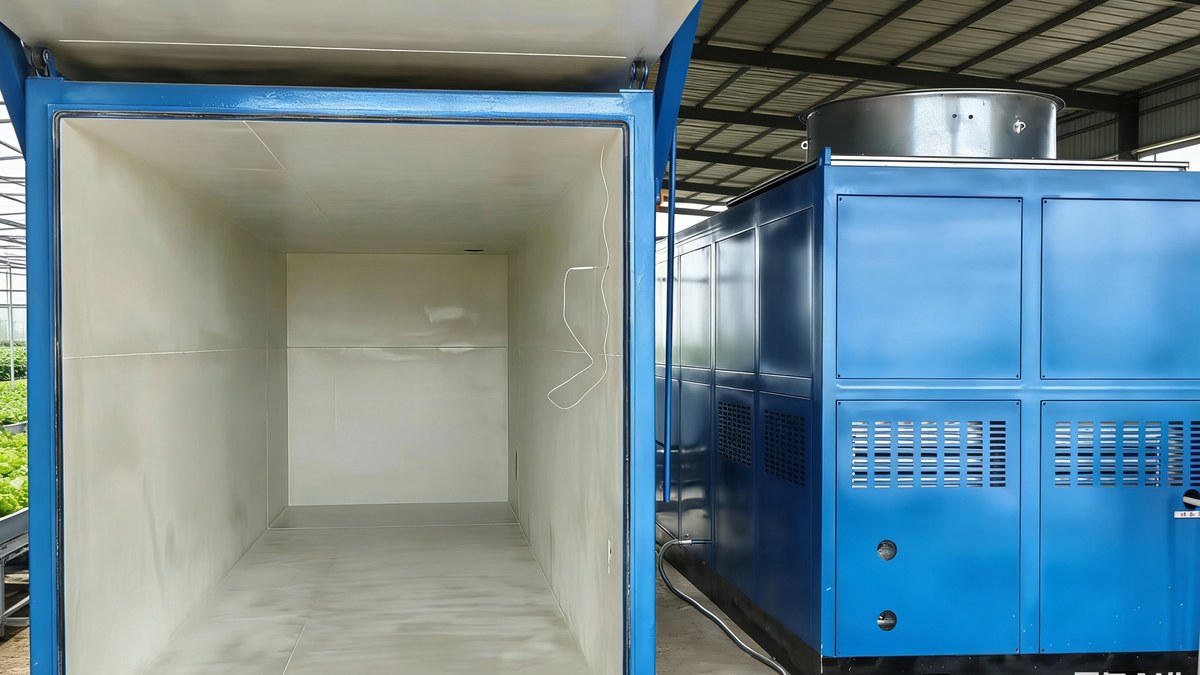
A complete food cold chain looks like this:
Cooking → Pre-cooling → Cold storage → Refrigerated transport → Store display → Home fridge
Every step fights temperature. But most factories focus on cold storage and trucks, ignoring the very first step: pre-cooling.
The cold chain’s weakest link is not in the middle — it’s at the start: rapid cooling.
The 60°C→30°C Danger Zone
Every food microbiologist knows this, but many factories don’t take it seriously:
60°C to 30°C is the bacterial expressway.
- Most pathogens (Salmonella, E. coli, Staphylococcus) divide every 20 minutes in this range
- From 90°C to 10°C, a traditional cold room takes 4–8 hours
- That’s 12+ generations of bacterial growth
- A batch at 10³ CFU/g becomes 10⁶~10⁷ CFU/g in hours
Rapid cooling logic is simple: shorten the time through this temperature zone so bacteria don’t have time to multiply.
Two Cooling Routes Compared
| Parameter | Traditional Cold Room | Vacuum Cooling (CVF Series) |
|---|---|---|
| Cooling method | Air convection | Vacuum evaporative self-cooling |
| 90°C→10°C time | 4–8 hours | 10–25 minutes |
| Through 60–30°C zone | 2–4 hours | 2–4 minutes |
| Final temp uniformity | Cold outside, hot core | Uniform throughout |
| Floor space | Large cold room needed | 3–10 m² equipment |
How the CVF Series Works
The CVF series covers models from CVF-50 to CVF-1000:
- Cooling time: 90°C→10°C in 20 minutes (standard)
- Capacity: 50–1,000 kg per batch
- Temp control: ±1°C
Real scenario: a braised meat factory. Before — cold room, spreading out, flipping, waiting — 6 hours total. After CVF-200 — 200 kg of beef, 20 minutes in, 9°C core temperature out. No surface frost, normal color, unchanged texture.
Those 20 minutes buy not efficiency — safety.
The Refrigeration System Is Not Optional
Some people think a vacuum cooler is just a vacuum pump sucking air.
Wrong.
The vacuum pump does one thing: remove non-condensable gases. The real work of removing heat is done by the refrigeration system.
The water catcher (condenser) is the evaporator of the refrigeration system. Water vapor from the food surface condenses on the cold coils, releasing ~2,260 kJ/kg of latent heat. The refrigerant loop carries this heat away to the cooling tower or ambient air.
Without refrigeration:
- Water vapor condenses inside the vacuum pump → oil emulsifies → pump dies
- Water vapor can’t be removed → system pressure won’t drop → cooling stops
- The machine becomes a steam generator, not a cooler
Energy Comparison
| Route | Energy Consumption |
|---|---|
| Traditional cold room | 0.15–0.25 kWh/kg |
| Vacuum cooling (CVF) | 0.10–0.18 kWh/kg |
Shelf Life Extension
| Product | Traditional Cooling | Vacuum Cooling | Improvement |
|---|---|---|---|
| Braised meat | 5–7 days | 12–18 days | 2–3× |
| Steamed pastries | 3–5 days | 8–12 days | 2–2.5× |
| Prepared dishes | 4–6 days | 10–14 days | 2–3× |
| Tofu products | 2–3 days | 5–7 days | 2×+ |
Summary
Rapid cooling is not a gimmick — it’s the prerequisite for a working cold chain. Vacuum cooling covers in 20 minutes what a cold room does in 4–8 hours, compressing the bacterial growth window to near-zero.
Three things — vacuum, water vapor, and refrigeration — working together to cool ten times faster than traditional methods.
Data from Yuanxian Machinery lab tests and third-party inspection reports. | vacuum-fresh.com