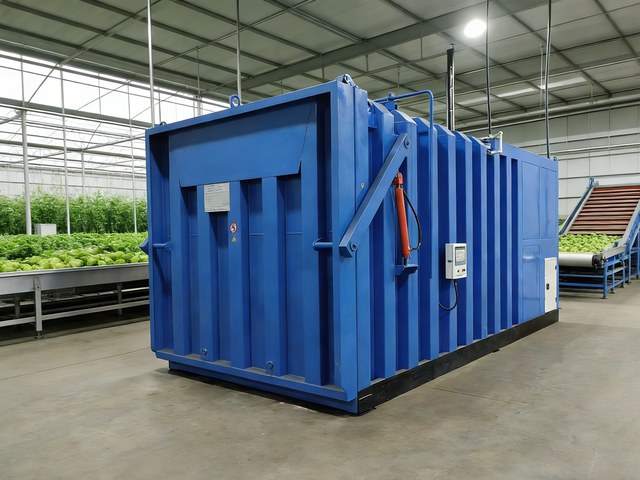
Customer Complaint: The Vacuum Cooler Is Too Slow — On-Site Inspection Found the Real Problem
A CVF-400 at a bakery in Tunisia was rated for a 15-minute cycle but fell far short in practice. An engineer's on-site check found the problem.
Interested in a Similar Solution?
Tell us about your product and capacity — we will prepare a tailored proposal for your application.
Ask About This Solution →Customer Complaint: The Vacuum Cooler Is Too Slow — On-Site Inspection Found the Real Problem
What the Customer Reported
“Our vacuum cooler is too slow. The manual says a 15-minute cycle, but it never gets close, and it is dragging down the whole line.”
The unit was a CVF-400 bread vacuum cooler at a bakery in Tunisia, with a design throughput of 350 kg per cycle. The customer had been using it for three years and had always assumed this was simply how fast vacuum cooling is.
It is not.
On-Site Inspection — What We Found
The engineer went to the site and looked at the vacuum pump first.
CVF-400 configuration:
| Parameter | Value |
|---|---|
| Model | CVF-400 |
| Throughput | 350 kg/cycle (4 carts × 86.4 kg) |
| Chamber | 6.6 m³ (2000×1500×2200mm) |
| Compressor | Maneurop MTZ-160, 12.7 kW |
| Actual cooling capacity | 30–36 kW (corrected) |
| Vacuum pump | Leybold SV300, 5.5 kW (single unit) |
| Final temperature | 30°C (ambient bread temperature) |
| Rated cycle | 15–20 min |
| Weight | 4,200 kg |
The SV300 vacuum pump has a displacement of about 180 m³/h at atmospheric pressure. With a target ultimate vacuum of 600 Pa and a 6.6 m³ chamber:
Pump-down time calculation:
t = (6.6 / 180) × ln(101325 / 600) × 1.3
  = 0.037 × 5.13 × 1.3
  = 0.24 hours = 14.4 minutes
The problem is immediately obvious:
- 15-minute cycle: 14.4 minutes (96%) is spent pumping — leaving 0.6 minutes of actual cooling
- 20-minute cycle: 14.4 minutes (72%) is spent pumping — leaving only 5.6 minutes of cooling
- With that little cooling time, the bread simply cannot reach 30°C
The customer was not imagining things. With a single pump on a 6.6 m³ chamber, a 15-minute cycle is physically impossible.
Root-Cause Analysis
The refrigeration system was actually fine. The Maneurop MTZ-160 compressor (12.7 kW, delivering 30–36 kW of actual cooling) is reasonable for cooling 350 kg of bread.
The heat load calculation checks out:
| Item | Value |
|---|---|
| Sensible heat (bread 100°C→30°C, Cp=2.7) | 66,150 kJ |
| Latent heat (3% weight loss = 10.5 kg water evaporated) | 26,250 kJ |
| Total heat load | 92,400 kJ |
| Refrigeration needed for 20 min | approx. 27 kW |
| Refrigeration available | 30–36 kW ✅ |
The problem lies squarely in the vacuum pump selection. A single SV300 is too small for a 6.6 m³ chamber.
The Solution: Upgrade to Twin Pumps
Recommended solution:
| Component | Original configuration | Upgrade | Effect |
|---|---|---|---|
| Vacuum pump | Leybold SV300×1 (180 m³/h) | SV300+SV200 twin pumps (280 m³/h) | Pump-down 14.4→7.2 min |
| Alternative | SV300×1 | Dalutong DLT-200×2 (Chinese-made) | Same effect, approx. 40% lower cost |
Twin-pump pump-down time:
t = (6.6 / 280) × 5.13 × 1.3 = 0.12h = 7.2 minutes
15-minute cycle: 7.2 min pump-down + 7.8 min cooling — feasible 20-minute cycle: 7.2 min pump-down + 12.8 min cooling — very comfortable
Other recommendations:
- Add a water ring pump (2BV5110) to handle wet vapour — bread tends to collapse under dry vacuum, and a water ring pump handles moisture-laden gas better
- Revise the cycle figures in the manual: 20–25 min for a single pump, 15–20 min for twin pumps
- Upgrade the old electrical control to a modern PLC and add bread-specific pressure curve control
- The Chinese-made Dalutong DLT-200 costs only 60% of a Leybold SV300 and can serve as a cost-reduction option
The Lesson
This case led us to add one check to every proposal we write:
Vacuum pump selection is the number one bottleneck in vacuum cooler cycle time.
Not the compressor, not the condenser — the vacuum pump.
Leaving 200% margin on the compressor makes no difference — if the vacuum pump spends 96% of the time pumping, there is no time left for cooling at all. Every engineer working on vacuum cooling should put the pump-down time calculation first, not last.
Bread cooling differs from meat and cooked foods. Bread only needs to come down to 30°C (room temperature), so the heat load is small, but its chamber volume per unit weight is large (bread has low density). That means pump-down time becomes the dominant constraint on the cycle.
Vacuum Cooler Self-Check List
- Calculate the pump-down time:
t = (chamber volume / pump displacement) × ln(atmospheric pressure / target vacuum) × 1.3 - Confirm that the pump-down time is ≤40% of the total cycle
- If pump-down exceeds 30%, consider a twin-pump configuration
- High-moisture products (bread, cake, cooked vegetables) must have a water ring pump
- Do not trust the cycle data of an old design — recalculate it with real pump performance curves
Need an Equipment Inspection?
If your vacuum cooler falls short of its rated cycle, the problem may be simple — one on-site inspection can identify the vacuum bottleneck, a cooling mismatch, or a control problem.
Contact us for a vacuum system review: www.yuanxianmachinery.com
Related articles:
- Everything about vacuum cooling for bread
- How to select a vacuum pump for a food vacuum cooler
- Common faults on vacuum coolers: a self-check guide
Case source: CVF-400 bread vacuum cooler in Tunisia, designed in 2015. On-site inspection in July 2026. The customer’s name has been withheld.
Interested in a Similar Solution?
Tell us about your product and capacity — we will prepare a tailored proposal for your application.
Ask About This Solution →