Bakery Cools 200 kg of Bread 100°C to 25°C: CVF-200
If bread is not cooled after leaving the oven, it turns sour by the next day. That is not an exaggeration; it is the daily arithmetic of a bakery.
Interested in a Similar Solution?
Tell us about your product and capacity — we will prepare a tailored proposal for your application.
Ask About This Solution →How a Bakery Cooled 200 kg of Bread from 100°C to 25°C: The Story of One CVF-200
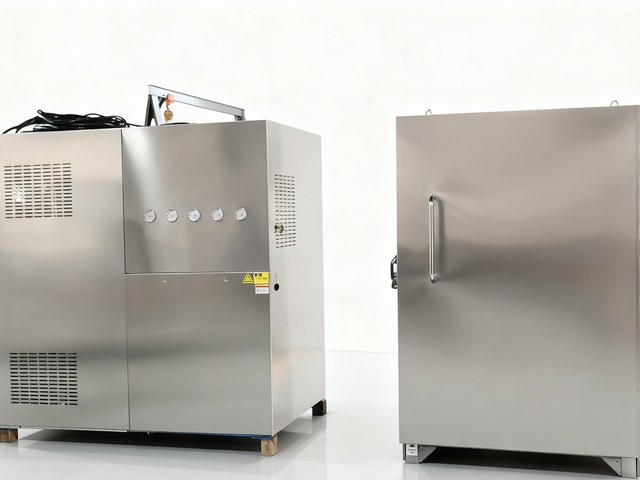
If bread is not cooled after leaving the oven, it turns sour by the next day. That is not an exaggeration; it is the daily arithmetic of a bakery. A bakery in Nepal once came to us with a simple requirement: 200 kg of bread per batch, cooled from 100°C to 25°C, with the cycle held within 20 minutes. Our solution was one CVF-200 food vacuum cooler with a 3.78 m³ vacuum chamber and a 35 kW refrigeration system. Measured cycle time was 15–20 minutes, processing 600 kg per hour.
The Real Problem the Customer Faced
That bakery makes staple bread in large volumes, but the cooling step kept lagging behind. The traditional method is to spread the bread on racks after baking and let it cool naturally — one to two hours in summer, and forty to fifty minutes even in winter. The problem is not the slowness itself, but that microorganisms keep growing during that slow period. The longer the bread’s internal temperature lingers in the 60°C–30°C range, the more bacteria multiply and the shorter the shelf life becomes. In the owner’s own words: “By the second day the bread is dry and sour, and we get a lot of returns.”
When we visited the site we ran the numbers: at their production volume at the time, more than 4 tons of bread had to be cooled every day. The floor space, labour, and turnover baskets tied up by natural cooling, plus the losses from returns, added up to no small sum over a year.
The Solution: CVF-200 Food Vacuum Cooler
The principle is not complicated. The bread goes into a sealed vacuum chamber; once the air is evacuated, the boiling point of water drops, moisture on the bread surface evaporates under low pressure, and the evaporation absorbs a large amount of heat. The refrigeration system supplies cooling to the vapour condenser so that water vapour condenses on its surface, while the vacuum pump is responsible only for removing non-condensable gases. The whole process relies neither on fans blowing air nor on a cold room freezing, but on water evaporating by itself.
The actual configuration of this unit:
| Parameter | Value |
|---|---|
| Model | CVF-200 |
| Capacity per cycle | 200 kg (approx. 600 kg per hour) |
| Cycle time | 15–20 minutes |
| Inlet temperature | approx. 100°C (loaded straight from the oven) |
| Final temperature | 25°C |
| Vacuum chamber volume | 3.78 m³ (L1500×W1400×H1800mm) |
| Cooling capacity | 35 kW (30,000 kcal/h) |
| Compressor | Maneurop, 5.8 kW |
| Vacuum pump | Leybold SV200B, 4 kW |
| Ultimate vacuum | ≤600 Pa |
| Operating power | 11.85 kW |
| Equipment weight | 4300 kg |
| Overall dimensions | L3800×W1700×H2200mm (excluding cooling tower) |
The refrigeration system uses a French Maneurop compressor and the vacuum system a German Leybold rotary-vane pump, with a Kaidi condenser and a control system combining Korean LS with a Taiwanese Weintek HMI. At the time this configuration was a mature combination in the baking industry, and it still looks like a reliable route today.
Actual Results and the Bakery’s Arithmetic
Three months after the equipment was installed, the plant reported three things.
First, cooling time dropped from one to two hours down to 15–20 minutes, and the shipping rhythm changed completely. Previously a large turnover area had to be reserved between baking and packing; now the bread goes straight from the oven into the vacuum chamber, batch after batch, and several more production shifts can be scheduled in a day.
Second, bread quality became stable. Having passed quickly through the danger temperature band, the product starts with a low microbial load, shelf life is extended, and the return rate drops noticeably. The internal structure of the bread is better preserved than with natural cooling, the crust does not dry out and crack, and by the second day the difference in mouthfeel is small.
Third, floor space and labour were saved. The racks, fans, and turnover baskets previously used for spreading and cooling were all withdrawn, and the cooling step no longer needs a dedicated person watching it.
For products with a moderate moisture content such as bread, the weight loss from vacuum cooling is itself very low — for baked goods it generally falls in the 0.5%–2% range, with very little effect on yield. This is also why bakeries can adopt vacuum cooling with confidence: the cooling is fast without losing too much moisture.
Who This Kind of Solution Suits
Here is a judgement standard for bakeries and baking plants considering vacuum cooling: if the volume out of the oven is large, natural cooling is eating up floor space, and shelf life keeps causing problems, the arithmetic is worth doing. The Nepali plant processes 200 kg per batch; our bakery cases range from 50 kg to 1000 kg per batch, with chamber size and cooling capacity following the throughput.
The selection logic is not complicated: first decide how many kilograms must be handled per batch, then set the inlet and final temperatures, and then calculate the required cooling capacity and chamber volume. For example, 200 kg per batch with a 25°C final temperature needs a configuration like the CVF-200; double the throughput and you are looking at the CVF-400 or larger. Yuanxian Machinery’s food vacuum cooler series covers 50–1000 kg per batch; you can find the matching model by throughput on the food vacuum cooler selection page.
Common Questions About Bread Cooling
Will vacuum cooling collapse the bread? No. The vacuum level is held within 600 Pa, the pressure change is gradual, and the interior of the bread is a honeycomb structure rather than a sealed cavity, so it will not deform or collapse. The Nepali plant has been running for three years without a single such problem.
Should the bread be packed immediately after cooling? We recommend moving to packing or refrigeration once the final temperature is around 25°C. If the bread is cooled all the way to refrigeration temperature before packing, condensation easily forms inside the package, which in fact harms the crust. 25°C is the temperature baking workshops most commonly use as the handover point.
How is weight loss controlled? Baked products have a modest moisture content to begin with, and vacuum cooling weight loss is usually 0.5%–2%. To control it further you can shorten the pump-down time, adjust the end-point vacuum level, or choose a configuration with a humidifying function. Specific parameters are measured against the actual product during selection.
Is maintenance troublesome? Day to day you mainly check the vacuum pump oil level and filter element, and the refrigeration system is serviced on the compressor manufacturer’s cycle. Rotary-vane pumps such as the Leybold SV200B have been used in baking workshops for many years and spare parts supply is stable.
Interested in a Similar Solution?
Tell us about your product and capacity — we will prepare a tailored proposal for your application.
Ask About This Solution →