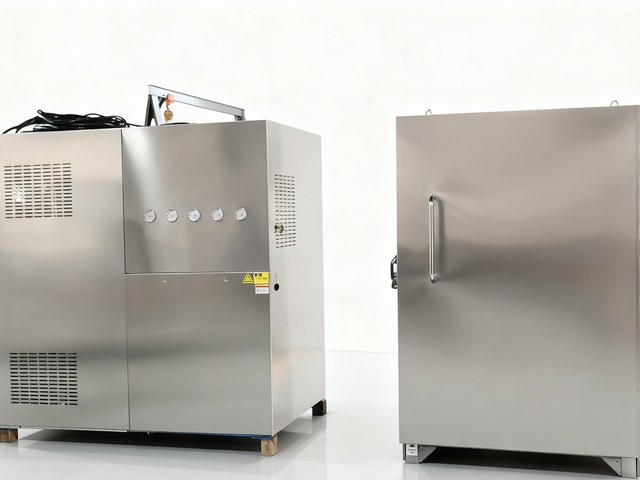
Origin Pre-Cooling: 12-Ton Vacuum Line in Mexico
Export produce leaves the field warm. In a growing region in Mexico, harvested vegetables were stacked in the packing area at 28–35°C.
Interested in a Similar Solution?
Tell us about your product and capacity — we will prepare a tailored proposal for your application.
Ask About This Solution →SEO Block
| Field | Content | |
|---|---|---|
| Title Tag | Origin Pre-Cooling for Export Produce: Mexico CVF-12000 Case | Vacuum-Fresh |
| Meta Description | Case study of a 12-ton-per-batch vacuum pre-cooler for a Mexican exporter: 66.56 m³ chamber, 0–10°C in 20–30 minutes, 480V/60Hz, Hanbell screw compressor + Leybold vacuum pumps. Origin pre-cooling is the first step of the export cold chain. | |
| Keywords | export produce pre-cooling, vacuum pre-cooler, field heat, CVF-12000, Mexico export, vacuum pre-cooling, first step of the cold chain | |
| H1 | Origin Pre-Cooling for Export Produce: A 12-Ton Vacuum Pre-Cooling Line in Mexico |
Origin Pre-Cooling for Export Produce: A 12-Ton Vacuum Pre-Cooling Line in Mexico
Export produce leaves the field warm. In a growing region in Mexico, harvested vegetables were stacked in the packing area at 28–35°C. Every extra hour at that temperature shortens the shelf life by a step — respiration cannot be brought down, moisture keeps being lost, and spoilage bacteria multiply first. The cold chain does not begin at customs clearance; it begins the moment field heat is pulled out.
That is what a vacuum pre-cooler does, and it is why an exporter in Mexico installed a 12-pallet, 12-ton-per-batch line.
Case: Mexico CVF-12000-12P
The line is a 12-pallet vacuum pre-cooler, model CVF-12000-12P. The parameters from the project file:
| Parameter | Value |
|---|---|
| Chamber volume | 66.56 m³ (L8000×W2600×H3200 mm) |
| Capacity per batch | 12,000 kg |
| Cycle | 20–30 minutes |
| Cooling capacity | 2×477.5 kW (2×410,600 kcal/h) |
| Compressor | 2×163 kW Hanbell (screw) |
| Vacuum pump | 4×15 kW Leybold SV0630B |
| Evaporative condenser | 28 kW |
| Ultimate vacuum | ≤600 Pa |
| Final temperature | 0–10°C |
| Power supply | 480V/60Hz/3P |
| Equipment weight | 26,500 kg |
Twelve pallets of produce go into the chamber, the door closes, and core temperature drops to single digits within half an hour. This is not a speed an air-blast cold room can achieve — vacuum cooling relies on surface moisture evaporating under low pressure, carrying heat out from inside the product.
Why Export Buyers Care About Pre-Cooling
Export contracts generally specify a receiving temperature. When hot cargo is loaded into a container, that heat travels the whole way with it; a cold room at the destination port can only slow further warming, not pull out the heat already inside the goods. Origin pre-cooling is the only step that can remove field heat close to the field.
A vacuum pre-cooler has three points of value for export operations:
- Cooling is compressed from the scale of hours to the scale of minutes. The same 12 tons takes 8–12 hours in a cold room, and 20–30 minutes under vacuum.
- Uniform cooling. All surfaces evaporate moisture at the same time, so the centre and the outside of a pallet do not show the temperature lag of forced-air cooling.
- Matching the packing rhythm. At a 20–30 minute cycle, several batches can pass through in an hour, keeping pace with harvest and packing throughput.
How the Refrigeration System Actually Works
A vacuum pre-cooler does not cool by drawing a vacuum alone. The chamber is brought down to about 600 Pa, moisture on the produce surface boils at that low temperature, and the phase change carries heat out of the product. That water vapour must be removed — if it stays in the chamber the pressure rises and cooling stops.
The vapour condenser (evaporator) is cooled by the refrigeration system to about −5°C to −15°C, and the water vapour in the chamber condenses on its cold surface, maintaining the low pressure. The vacuum pump only removes non-condensable gases; it is not responsible for cooling. Remove the refrigeration, or size it too small, and the pump oil emulsifies within minutes and the equipment simply stops. Every vacuum cooling and freeze-drying unit we build follows this rule.
On the refrigeration side this machine uses two Hanbell RC2-510B screw compressors (2×163 kW) with a 28 kW evaporative condenser to reject the heat; on the vacuum side, four Leybold SV0630B rotary-vane pumps (15 kW×4) pull the chamber down to ≤600 Pa.
How to Select a Pre-Cooler for an Export Line
Start by fixing the capacity per batch. Twelve tons per batch means cooling 12 tons in 30 minutes, or roughly 24 tons per hour at full cycling rate. Chamber volume follows the pallet count: 12 pallets require 66.56 m³, with enough space left between pallets for water vapour to flow.
The power supply matters greatly on export projects. This machine uses 480V/60Hz/3P (the North American standard), with a maximum running current of about 856 A and a start-up peak of 965 A — the on-site electrical design has to be worked out before shipment, not patched in once the equipment arrives.
A Few Things to Check Before Buying
- Confirm the target final temperature with the buyer (0–10°C on this machine; some contracts require ≤4°C, which calls for a larger vapour condenser area).
- Size the capacity per batch to the harvest/packing rate, not to the largest figure in the manual.
- Check the local power standard (60 Hz or 50 Hz, voltage level) so the compressor and vacuum pump motors can be selected correctly.
- Ask for sustained cooling capacity (under vapour-condensing conditions), not just the nominal kcal/h figure.
Full parameters for the complete range of produce vacuum pre-coolers (2–12 pallets, air-cooled/water-cooled/evaporative) are available at vacuum-fresh.com. Field heat is the most easily overlooked step in the cold chain — pulling it out in 30 minutes rather than spending 10 hours on it is the whole point of a pre-cooler.
Note: This article is based on a real project file (DIANA, Mexico, CVF-12000-12P). The parameters are quoted directly from the engineering records.
Interested in a Similar Solution?
Tell us about your product and capacity — we will prepare a tailored proposal for your application.
Ask About This Solution →